LaTeX research proposal template
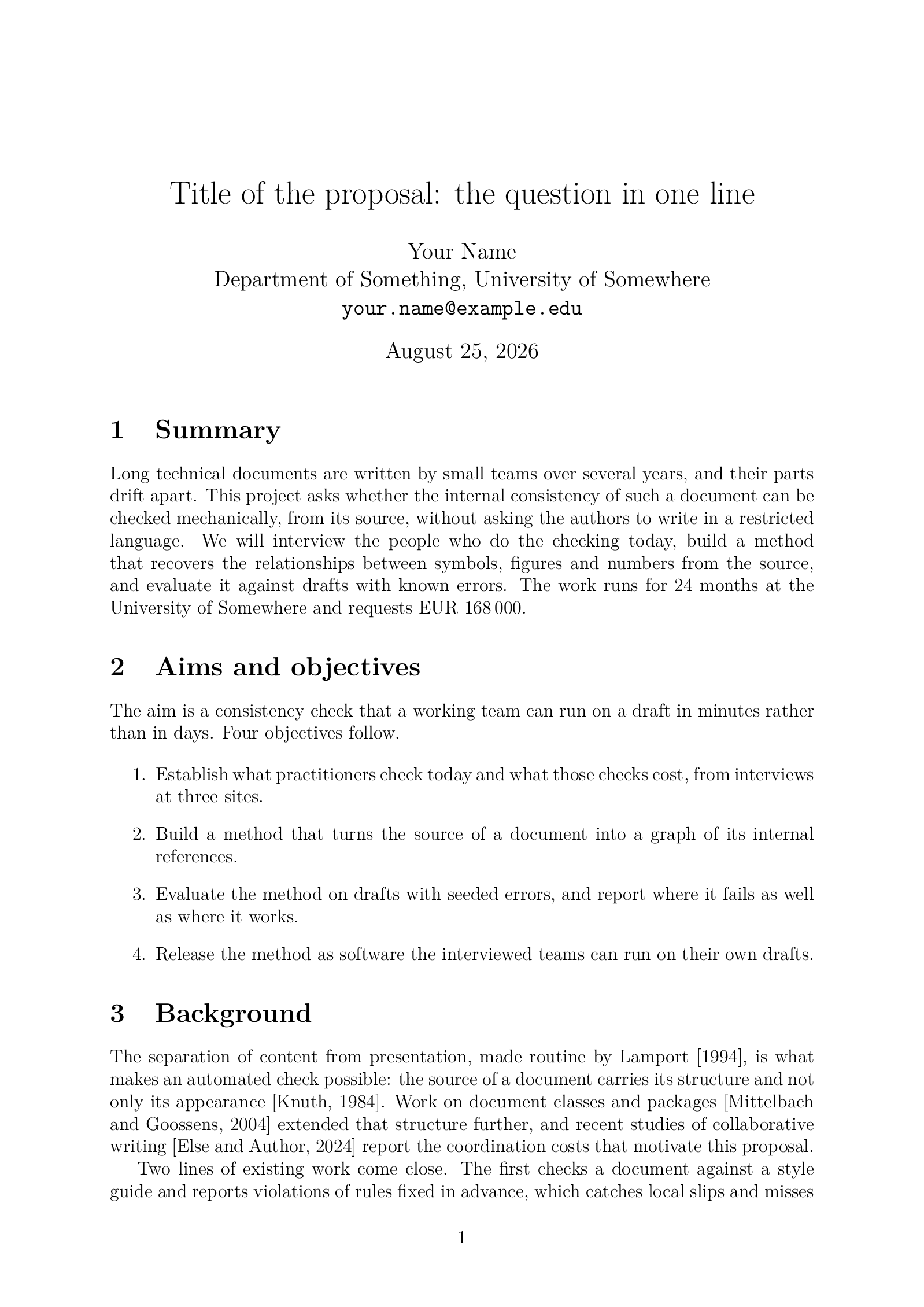
A LaTeX research proposal template for a funding call, a PhD application or a project pitch.
- Engine: pdfLaTeX
- Bibliography: BibTeX
- License: Public domain, use freely.
Open in LaTeX.to Download all files (zip)
Files:
main.tex
% !BIB program = bibtex
\documentclass[12pt,a4paper]{article}

\usepackage[T1]{fontenc}
\usepackage{lmodern}
\usepackage[margin=2.5cm]{geometry}  % the margins the call asks for
\usepackage{amsmath}
\usepackage{booktabs}
\usepackage{natbib}
\usepackage[hidelinks]{hyperref}     % hyperref goes last

\title{Title of the proposal: the question in one line}

% Name, affiliation and contact for the lead applicant.
\author{Your Name \\
  Department of Something, University of Somewhere \\
  \texttt{[email protected]}}

\date{\today}

\begin{document}

\maketitle

\section{Summary}

Long technical documents are written by small teams over several years, and
their parts drift apart. This project asks whether the internal consistency of
such a document can be checked mechanically, from its source, without asking
the authors to write in a restricted language. We will interview the people who
do the checking today, build a method that recovers the relationships between
symbols, figures and numbers from the source, and evaluate it against drafts
with known errors. The work runs for 24 months at the University of Somewhere
and requests EUR 168\,000.

\section{Aims and objectives}

The aim is a consistency check that a working team can run on a draft in
minutes rather than in days. Four objectives follow.

\begin{enumerate}
  \item Establish what practitioners check today and what those checks cost,
        from interviews at three sites.
  \item Build a method that turns the source of a document into a graph of its
        internal references.
  \item Evaluate the method on drafts with seeded errors, and report where it
        fails as well as where it works.
  \item Release the method as software the interviewed teams can run on their
        own drafts.
\end{enumerate}

\section{Background}

The separation of content from presentation, made routine by
\citet{lamport1994}, is what makes an automated check possible: the source of a
document carries its structure and not only its appearance
\citep{knuth1984}. Work on document classes and packages
\citep{mittelbach2004} extended that structure further, and recent studies of
collaborative writing \citep{someone2024} report the coordination costs that
motivate this proposal.

Two lines of existing work come close. The first checks a document against a
style guide and reports violations of rules fixed in advance, which catches
local slips and misses everything that spans a chapter. The second compares
versions of the same document and reports what changed, which needs a baseline
that a first draft does not have. Neither recovers the relationships inside a
single draft, and that is the gap this project addresses.

\section{Methods}

The method has three stages. The source is parsed once into a structured form,
the structure is turned into a graph whose nodes are symbols, figures, tables
and numbers, and the graph is queried for the patterns that indicate an
inconsistency. The stages are independent, so a parser for a new input format
does not touch the queries.

The evaluation is a within document comparison against the manual check, on
drafts with seeded errors. Assuming a difference in recovery rate of 15
percentage points, a standard deviation of 20 points, 5 percent significance
and 80 percent power, the number of drafts needed per arm is

\begin{equation}
  n = \frac{2 (z_{1-\alpha/2} + z_{1-\beta})^2 \sigma^2}{\delta^2} \approx 28 ,
\end{equation}

so the 120 drafts of the pilot study are enough to detect an effect of that
size with room for attrition. Interviews are transcribed and coded by two
researchers independently, and disagreements are settled by discussion.

\section{Work plan}

The project runs for 24 months in five work packages, listed in
Table~\ref{tab:timeline}. The packages overlap deliberately: data collection
starts before the study design is finished so that the design can be corrected
while the sites are still open.

\begin{table}[htbp]
  \centering
  \caption{Work plan for the 24 months of the project.}
  \label{tab:timeline}
  \begin{tabular}{llll}
    \toprule
    Package & Months & Activity & Deliverable \\
    \midrule
    WP1 & 1 to 4   & Interviews and study design      & Protocol \\
    WP2 & 3 to 10  & Data collection at three sites   & Cleaned corpus \\
    WP3 & 9 to 16  & Method development               & Software release \\
    WP4 & 15 to 22 & Evaluation on the held out set   & Evaluation report \\
    WP5 & 20 to 24 & Reporting and dissemination      & Two journal papers \\
    \bottomrule
  \end{tabular}
\end{table}

Risk is concentrated in WP2, since it depends on three sites granting access to
drafts they consider confidential. Two further sites have agreed to act as
replacements, and the pilot corpus is already available under an agreement
signed at the start of the project.

\section{Expected outcomes}

The project will produce an account of current practice that no published study
provides, a method with a stated failure mode rather than a headline number,
and a software release the interviewed teams can run themselves. Two journal
papers and one conference paper are planned, and the corpus will be published
in the form the site agreements allow. The wider outcome is a check that costs
minutes, which changes when a team can afford to run it: before every draft
rather than before every deadline.

\section{Budget}

Table~\ref{tab:budget} lists the requested costs. Salaries follow the
university scale for the grades named and include employer contributions.

\begin{table}[htbp]
  \centering
  \caption{Requested budget, in euros.}
  \label{tab:budget}
  \begin{tabular}{lr}
    \toprule
    Item & Amount \\
    \midrule
    Postdoctoral researcher, 24 months & 96\,000 \\
    Doctoral researcher, 24 months     & 48\,000 \\
    Computing and storage              & 12\,000 \\
    Travel to the three sites          &  6\,000 \\
    Publication costs                  &  6\,000 \\
    \midrule
    Total                              & 168\,000 \\
    \bottomrule
  \end{tabular}
\end{table}

The university contributes the office space, the supervision time of the lead
applicant and the licenses the project needs, which are not part of the
request.

\bibliographystyle{plainnat}
\bibliography{references}

\end{document}
references.bib
@book{knuth1984,
  author    = {Donald E. Knuth},
  title     = {The {\TeX}book},
  publisher = {Addison-Wesley},
  address   = {Reading, MA},
  year      = {1984}
}

@book{lamport1994,
  author    = {Leslie Lamport},
  title     = {{\LaTeX}: A Document Preparation System},
  edition   = {2},
  publisher = {Addison-Wesley},
  address   = {Reading, MA},
  year      = {1994}
}

@book{mittelbach2004,
  author    = {Frank Mittelbach and Michel Goossens},
  title     = {The {\LaTeX} Companion},
  edition   = {2},
  publisher = {Addison-Wesley},
  address   = {Boston, MA},
  year      = {2004}
}

@article{someone2024,
  author  = {Someone Else and Another Author},
  title   = {A Paper You Cite in the Background Section},
  journal = {Journal of Somewhere},
  volume  = {12},
  number  = {3},
  pages   = {45--67},
  year    = {2024}
}
How to use this template
Everything runs in your browser: nothing to install, no login, no compile timeout.
- Click Open in LaTeX.to. The template opens as a project in the Projects pane, with main.tex in the editor and its finished PDF in the preview.
- Click Preview, or press Ctrl+Enter (Cmd+Enter on a Mac), to compile. The preview shows the new PDF; you do not need to save first.
- If the compile fails, the Console pane opens with the LaTeX log. The first error in it says what went wrong and on which line.
- To add an image, a .bib file or another .tex file, open the project's menu (the three dots next to its name in the Projects pane) and choose Upload file or New file.
- The arrow next to Preview has Download PDF. Ctrl+S saves your edits, and the project stays in your browser on this device.
How to change the work plan
The timeline is a plain table, one row per work package.
- In the
tabularunder\label{tab:timeline}, each row isWP1 & 1 to 4 & Interviews and study design & Protocol \\: the package, the months, the activity and the deliverable. - Add or delete rows between
\midruleand\bottomrule; keep the&between the columns and the\\at the end. - Change the sentence above the table that says how many months and packages the project has.
How to turn it into a PhD proposal
A PhD proposal has no budget and names a supervisor.
- Delete from
\section{Budget}down to the paragraph that ends withnot part of the request. - Add a line
Supervisor: Dr.\ Someone Elseinside the\author{...}block, after your own details, with\\before it. - Expand Background and Methods, which carry the weight when there is no budget to judge.
How to add a reference
References come from references.bib, and BibTeX runs by itself when you compile.
- Click
references.bibin the Projects pane and add an entry; copy an existing one and change the key, authors, title, journal and year. - Cite it with
\citep{key}for "(Author, 2024)" in brackets or\citet{key}for "Author (2024)" in the sentence. - The list at the end is sorted by author and updates on the next compile.
More templates: ACM paper, Beamer presentation, Elsevier article, IEEE paper, Research paper, Poster, Thesis and all templates.