ElegantNote LaTeX template
The ElegantNote LaTeX template is the ElegantLaTeX team's class for lecture and study notes, with page sizes made for reading on a tablet, a Kindle or a screen.
- Engine: pdfLaTeX (English), XeLaTeX (Chinese)
- Bibliography: biblatex (Biber)
- Source: ElegantLaTeX/ElegantNote 1.1k e45cde7 28 Sep 2026
- License: LPPL 1.3c
English
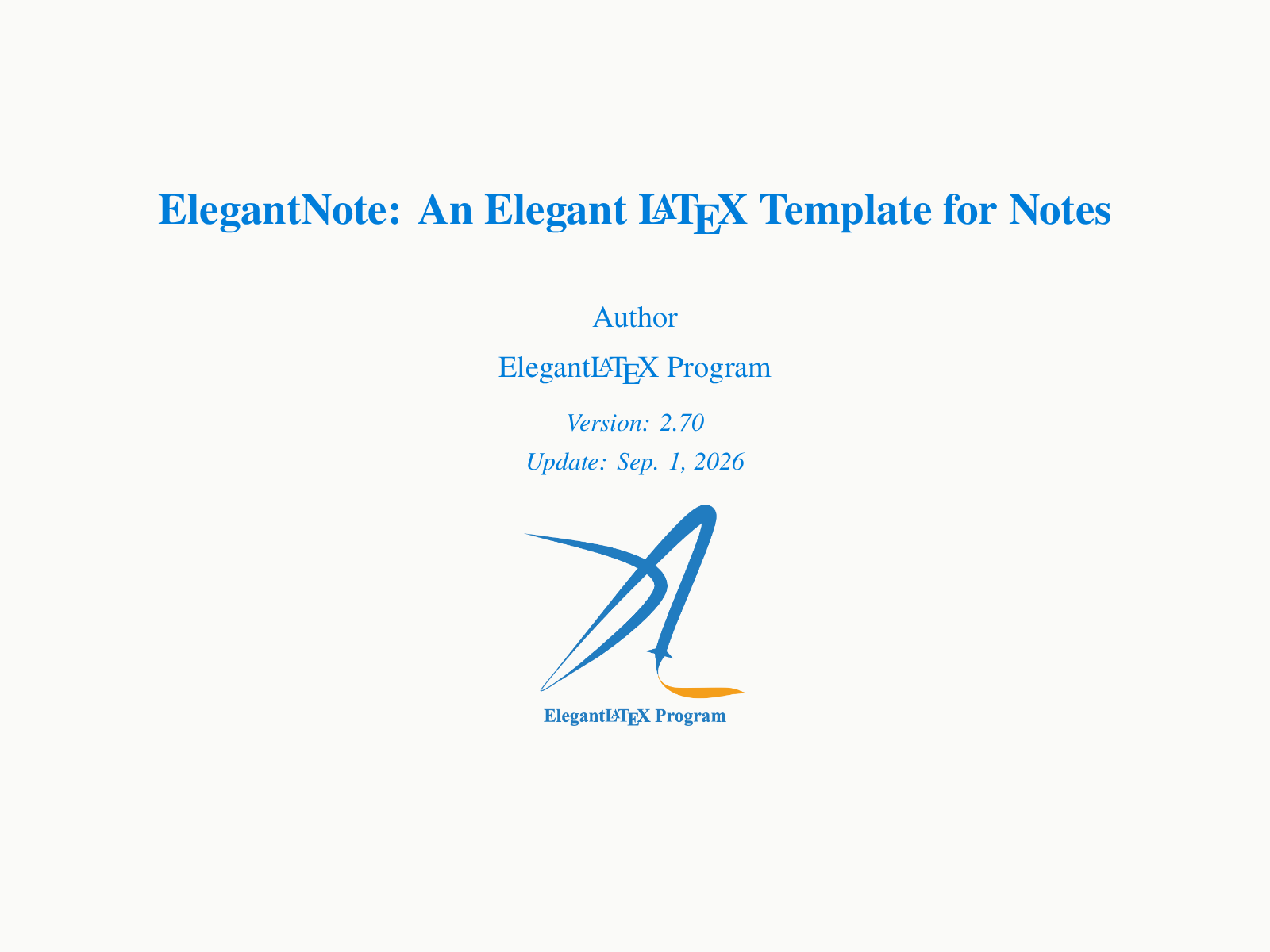
Open in LaTeX.to Download all files (zip)
elegantnote-en.tex
\documentclass[en,hazy,blue,screen,14pt]{elegantnote}

\title{ElegantNote: An Elegant \LaTeX\ Template for Notes}

\author{Author}
\institute{Elegant\LaTeX\ Program}

\version{2.70}
\date{Sep. 1, 2026}

\addbibresource[location=local]{reference.bib}

\begin{document}
\maketitle
% logo
\centerline{\includegraphics[width=0.2\textwidth]{logo-blue}}

\section{ElegantNote Instructions}
\thispagestyle{empty}
\textcolor{red}{\bfseries Caution: This template will no longer be maintained since January 1st, 2023. However, due to its user base, maintenance has resumed and the template has been re-released as of 2026.}

The brand new ElegantNote is redesigned on the basis of \LaTeX\ article, a more elegant note template! You can use either \hologo{pdfLaTeX} or \hologo{XeLaTeX} to compile. It is recommended that \hologo{pdfLaTeX} be used for notes in English while \hologo{XeLaTeX} be used for notes in Chinese.


The new template has the following features:
\begin{itemize}
  \item two modes: good for eye mode (geye) and hazy mode;
  \item different devices: Pad (default), Screen(beamer size), Kindle, PC (double-page) and normal (A4);
  \item 5 color themes: \textcolor{eblue}{blue} (default),  \textcolor{egreen}{green}, \textcolor{ecyan}{cyan}, \textcolor{sakura}{sakura} and \textcolor{black}{black};
  \item languages support: Chinese (default), English;
  \item support \hologo{pdfLaTeX} and \hologo{XeLaTeX};
  \item prettier captions, list environments, and unified fonts;
  \item custmized global font size: 8pt, 9pt, 10pt, 11pt, 12pt, 14pt, 17pt and 20pt;
  \item support for math font options for \lstinline{newtx} and \lstinline{mtpro2};
  \item with the option of \lstinline{bibstyle} (default: apalike) for changing style of bibliography;
  \item change the citation style with \lstinline{cite} option: \lstinline{authoryear}, \lstinline{numbers} and \lstinline{super}.
\end{itemize}

\subsection{Optional Modes}

This template provides optional modes: good for eye mode (geye) and hazy mode, while the paper color is green for the former and light blue for the latter. you can use the following code to activate the desired mode:
\begin{lstlisting}[frame=none]
  \documentclass[geye]{elegantnote} % or
  \documentclass[mode=geye]{elegantnote}
  \documentclass[hazy]{elegantnote} % or
  \documentclass[mode=hazy]{elegantnote}
\end{lstlisting}

\begin{remark}
  If you are expected to customize background, use:
  \begin{lstlisting}
    \definecolor{geyecolor}{RGB}{199,237,204}
    \pagecolor{geyecolor}
  \end{lstlisting}
\end{remark}


\subsection{Device Options}

To make the notes more comfortable to read, we designed four output options (of different sizes) that correspond to different reading devices: Pad (default), Kindle, PC and A4paper.

\textcolor{red}{New}: For the convenience of notes presentation, version 2.20 offers a new option for device, i.e. \lstinline{device=screen}, which is similar to the size of MS Powerpoint with ratio aspect of 4:3 (2019/12/06).

The options of output for different devices are
\begin{lstlisting}[frame=none]
  \documentclass[device=pad]{elegantnote}    % ipad screen size
  \documentclass[device=kindle]{elegantnote} % kindle screen size
  \documentclass[device=pc]{elegantnote}     % double pages for pc
  \documentclass[device=normal]{elegantnote} % a4 normal page
  \documentclass[device=screen]{elegantnote} % 4:3 PPT size
\end{lstlisting}

\begin{note}
You can also select the device by using a direct assignment method, such as:
\end{note}

\begin{lstlisting}[frame=none]
  \documentclass[pad]{elegantnote}
  \documentclass[kindle]{elegantnote}
  \documentclass[pc]{elegantnote}
  \documentclass[normal]{elegantnote}
  \documentclass[screen]{elegantnote}
\end{lstlisting}

\begin{note}
To get a normal A4paper size PDF, please select \lstinline{device=normal}.
\end{note}

\subsection{Math Fonts}

This template defines a new option (\lstinline{math}), with three options:

\begin{enumerate}
  \item \lstinline{math=cm} (default), use \LaTeX\ default math font (recommended).
  \item \lstinline{math=newtx}, use \lstinline{newtxmath} math font (may bring about bugs).
  \item \lstinline{math=mtpro2}, use \lstinline{mtpro2} package to set math font.
\end{enumerate}


\subsection[Color Themes]{Color Themes\footnote{Test for chapter footnote.}}

This template contains 5 color themes, \textcolor{egreen}{green}, \textcolor{ecyan}{cyan}, \textcolor{eblue}{blue}(default), \textcolor{sakura}{sakura} and \textcolor{black}{black}. If you don't need color, you can choose black theme. The color theme is enabled in the same way as before:
\begin{lstlisting}[frame=none]
  \documentclass[green]{elegantnote}
  \documentclass[color=green]{elegantnote}
  ....
  \documentclass[black]{elegantnote}
  \documentclass[color=black]{elegantnote}
\end{lstlisting}


\subsection{Languages}

This template contains two sets of language environments, changing the language environment will change the title of table/figure (figure, table), article structure words (such as the table of contents, references, etc.), and the environment Introductory words (such as Theorem, Lemma, etc.). The different language modes are enabled as follows:
\begin{lstlisting}[frame=none]
  \documentclass[cn]{elegantnote}
  \documentclass[lang=cn]{elegantnote}
  \documentclass[en]{elegantnote}
  \documentclass[lang=en]{elegantnote}
\end{lstlisting}

\begin{note}
Chinese characters are allowed in Chinese mode only. To type in Chinese characters in English mode, please include \lstinline{ctex}\footnote{Please use \lstinline{scheme=plain} to retain headlines in English.} or \lstinline{xeCJK} package.
\end{note}


\subsection{Theorem Class Environments}

This template used the \lstinline{amsthm} to create theorems, there are 4 types of theorem environments
\begin{itemize}
  \item \textbf{Theorem-Class}: theorem, lemma, proposition, corollary;
  \item \textbf{Definition-Class}: definition, conjecture, example;
  \item \textbf{Remark-Class}: remark, note, case;
  \item \textbf{Proof-Class}: proof.
\end{itemize}

\begin{remark}
With the option \lstinline{lang=cn} , the introductory words of the theorem class environments will be changed to Chinese.
\end{remark}


\section{Writing Sample}

We will define the integral of a measurable function in three steps. First, we define the integral of a nonnegative simple function. Let $E$ be the measurable set in $\mathcal{R}^N$.

% source: https://www.maths.tcd.ie/~dwilkins/LaTeXPrimer/Theorems.html

\begin{definition}[Left Coset]
Let $H$ be a subgroup of a group~$G$.  A \emph{left coset} of $H$ in $G$ is a subset of $G$ that is of the form $xH$, where $x \in G$ and $xH = \{ xh : h \in H \}$. Similarly a \emph{right coset} of $H$ in $G$ is a subset of $G$ that is of the form $Hx$, where $Hx = \{ hx : h \in H \}$
\end{definition}

Note that a subgroup~$H$ of a group $G$ is itself a left coset of $H$ in $G$.

\begin{lemma}[Size Of Left Coset]
Let $H$ be a finite subgroup of a group $G$.  Then each left
coset of $H$ in $G$ has the same number of elements as $H$.
\end{lemma}

\begin{theorem}[Lagrange's Theorem]
Let $G$ be a finite group, and let $H$ be a subgroup
of $G$.  Then the order of $H$ divides the order of $G$.
\end{theorem}

\begin{proof}
Let $z$ be some element of $xH \cap yH$.  Then $z = xa$ for some $a \in H$, and $z = yb$ for some $b \in H$. If $h$ is any element of $H$ then $ah \in H$ and $a^{-1}h \in H$, since $H$ is a subgroup of $G$. But $zh = x(ah)$ and $xh = z(a^{-1}h)$ for all $h \in H$. Therefore $zH \subset xH$ and $xH \subset zH$, and thus $xH = zH$.  Similarly $yH = zH$, and thus $xH = yH$, as required.
\end{proof}

\begin{figure}[!htbp]
	\centering
	\includegraphics[width=0.6\textwidth]{scatter.pdf}
	\caption{Matplotlib: Scatter Plot Example\label{fig:mpg}}
\end{figure}

Regression analysis is a powerful statistical method that allows you to examine the relationship between two or more variables of interest. While there are many types of regression analysis, at their core they all examine the influence of one or more independent variables on a dependent variable. The process of performing a regression allows you to confidently determine which factors matter most, which factors can be ignored, and how these factors influence each other.

Let's continue using our application training example. In this case, we'd want to measure the historical levels of satisfaction with the events from the past three years or so, as well as any information possible in regards to the independent variables.

\begin{table}[htbp]
  \small
  \centering
  \caption{Auto MPG and Price \label{tab:reg}}
    \begin{tabular}{lcc}
    \toprule
                    &       (1)         &        (2)      \\
    \midrule
    mpg             &    -238.90***     &      -49.51     \\
                    &     (53.08)       &      (86.16)    \\
    weight          &                   &      1.75***    \\
                    &                   &      (0.641)    \\
    constant        &     11,253***     &       1,946     \\
                    &     (1,171)       &      (3,597)   \\
    obs             &        74         &         74     \\
    $R^2$           &      0.220        &       0.293    \\
    \bottomrule
    \multicolumn{3}{l}{\scriptsize Standard errors in parentheses} \\
    \multicolumn{3}{l}{\scriptsize *** $p<0.01$, ** $p<0.05$, * $p<0.1$} \\
    \end{tabular}%
\end{table}%


\begin{itemize}[noitemsep]
  \item Routing and resource discovery;
    \begin{itemize}
      \item Language Models
      \item Vector Space Models
    \end{itemize}
  \item Resilient and scalable computer networks;
  \item Distributed storage and search.
\end{itemize}


\section{Acknowledgement}

Thank \href{https://github.com/sikouhjw}{sikouhjw} and \href{https://github.com/syvshc}{syvshc} for their quick response to Github issues and continuously support work for Elegant\LaTeX{}. Thank China\TeX\ and \href{http://www.latexstudio.net/}{LaTeX Studio} for their promotion.


\section{FAQ}

\begin{enumerate}[label=\arabic*).]
	\item \textit{How to remove the information of version?}\\
    Please comment \lstinline|\version{x.xx}|.
	\item \textit{How to remove the information of date?}\\
	  Please type in \lstinline|\date{}|.
	\item \textit{How to add several authors?}\\
	  Use \lstinline{\and} in \lstinline{\author} and use \lstinline{\\} to start a new line.
    \begin{lstlisting}
      \author{author 1\\ org. 1 \and author 2 \\ org. 2 }
    \end{lstlisting}
\end{enumerate}


%\printbibliography[heading=bibintoc, title=\ebibname]

\end{document}
image/logo-blue.png

image/scatter.pdf
License
The LaTeX Project Public License
=-=-=-=-=-=-=-=-=-=-=-=-=-=-=-=-

LPPL Version 1.3c  2008-05-04

Copyright 1999 2002-2008 LaTeX3 Project
    Everyone is allowed to distribute verbatim copies of this
    license document, but modification of it is not allowed.


PREAMBLE
========

The LaTeX Project Public License (LPPL) is the primary license under
which the LaTeX kernel and the base LaTeX packages are distributed.

You may use this license for any work of which you hold the copyright
and which you wish to distribute.  This license may be particularly
suitable if your work is TeX-related (such as a LaTeX package), but
it is written in such a way that you can use it even if your work is
unrelated to TeX.

The section `WHETHER AND HOW TO DISTRIBUTE WORKS UNDER THIS LICENSE',
below, gives instructions, examples, and recommendations for authors
who are considering distributing their works under this license.

This license gives conditions under which a work may be distributed
and modified, as well as conditions under which modified versions of
that work may be distributed.

We, the LaTeX3 Project, believe that the conditions below give you
the freedom to make and distribute modified versions of your work
that conform with whatever technical specifications you wish while
maintaining the availability, integrity, and reliability of
that work.  If you do not see how to achieve your goal while
meeting these conditions, then read the document `cfgguide.tex'
and `modguide.tex' in the base LaTeX distribution for suggestions.


DEFINITIONS
===========

In this license document the following terms are used:

   `Work'
    Any work being distributed under this License.

   `Derived Work'
    Any work that under any applicable law is derived from the Work.

   `Modification'
    Any procedure that produces a Derived Work under any applicable
    law -- for example, the production of a file containing an
    original file associated with the Work or a significant portion of
    such a file, either verbatim or with modifications and/or
    translated into another language.

   `Modify'
    To apply any procedure that produces a Derived Work under any
    applicable law.

   `Distribution'
    Making copies of the Work available from one person to another, in
    whole or in part.  Distribution includes (but is not limited to)
    making any electronic components of the Work accessible by
    file transfer protocols such as FTP or HTTP or by shared file
    systems such as Sun's Network File System (NFS).

   `Compiled Work'
    A version of the Work that has been processed into a form where it
    is directly usable on a computer system.  This processing may
    include using installation facilities provided by the Work,
    transformations of the Work, copying of components of the Work, or
    other activities.  Note that modification of any installation
    facilities provided by the Work constitutes modification of the Work.

   `Current Maintainer'
    A person or persons nominated as such within the Work.  If there is
    no such explicit nomination then it is the `Copyright Holder' under
    any applicable law.

   `Base Interpreter'
    A program or process that is normally needed for running or
    interpreting a part or the whole of the Work.

    A Base Interpreter may depend on external components but these
    are not considered part of the Base Interpreter provided that each
    external component clearly identifies itself whenever it is used
    interactively.  Unless explicitly specified when applying the
    license to the Work, the only applicable Base Interpreter is a
    `LaTeX-Format' or in the case of files belonging to the
    `LaTeX-format' a program implementing the `TeX language'.


CONDITIONS ON DISTRIBUTION AND MODIFICATION
===========================================

1.  Activities other than distribution and/or modification of the Work
are not covered by this license; they are outside its scope.  In
particular, the act of running the Work is not restricted and no
requirements are made concerning any offers of support for the Work.

2.  You may distribute a complete, unmodified copy of the Work as you
received it.  Distribution of only part of the Work is considered
modification of the Work, and no right to distribute such a Derived
Work may be assumed under the terms of this clause.

3.  You may distribute a Compiled Work that has been generated from a
complete, unmodified copy of the Work as distributed under Clause 2
above, as long as that Compiled Work is distributed in such a way that
the recipients may install the Compiled Work on their system exactly
as it would have been installed if they generated a Compiled Work
directly from the Work.

4.  If you are the Current Maintainer of the Work, you may, without
restriction, modify the Work, thus creating a Derived Work.  You may
also distribute the Derived Work without restriction, including
Compiled Works generated from the Derived Work.  Derived Works
distributed in this manner by the Current Maintainer are considered to
be updated versions of the Work.

5.  If you are not the Current Maintainer of the Work, you may modify
your copy of the Work, thus creating a Derived Work based on the Work,
and compile this Derived Work, thus creating a Compiled Work based on
the Derived Work.

6.  If you are not the Current Maintainer of the Work, you may
distribute a Derived Work provided the following conditions are met
for every component of the Work unless that component clearly states
in the copyright notice that it is exempt from that condition.  Only
the Current Maintainer is allowed to add such statements of exemption
to a component of the Work.

  a. If a component of this Derived Work can be a direct replacement
     for a component of the Work when that component is used with the
     Base Interpreter, then, wherever this component of the Work
     identifies itself to the user when used interactively with that
     Base Interpreter, the replacement component of this Derived Work
     clearly and unambiguously identifies itself as a modified version
     of this component to the user when used interactively with that
     Base Interpreter.

  b. Every component of the Derived Work contains prominent notices
     detailing the nature of the changes to that component, or a
     prominent reference to another file that is distributed as part
     of the Derived Work and that contains a complete and accurate log
     of the changes.

  c. No information in the Derived Work implies that any persons,
     including (but not limited to) the authors of the original version
     of the Work, provide any support, including (but not limited to)
     the reporting and handling of errors, to recipients of the
     Derived Work unless those persons have stated explicitly that
     they do provide such support for the Derived Work.

  d. You distribute at least one of the following with the Derived Work:

       1. A complete, unmodified copy of the Work;
          if your distribution of a modified component is made by
          offering access to copy the modified component from a
          designated place, then offering equivalent access to copy
          the Work from the same or some similar place meets this
          condition, even though third parties are not compelled to
          copy the Work along with the modified component;

       2. Information that is sufficient to obtain a complete,
          unmodified copy of the Work.

7.  If you are not the Current Maintainer of the Work, you may
distribute a Compiled Work generated from a Derived Work, as long as
the Derived Work is distributed to all recipients of the Compiled
Work, and as long as the conditions of Clause 6, above, are met with
regard to the Derived Work.

8.  The conditions above are not intended to prohibit, and hence do not
apply to, the modification, by any method, of any component so that it
becomes identical to an updated version of that component of the Work as
it is distributed by the Current Maintainer under Clause 4, above.

9.  Distribution of the Work or any Derived Work in an alternative
format, where the Work or that Derived Work (in whole or in part) is
then produced by applying some process to that format, does not relax or
nullify any sections of this license as they pertain to the results of
applying that process.

10. a. A Derived Work may be distributed under a different license
       provided that license itself honors the conditions listed in
       Clause 6 above, in regard to the Work, though it does not have
       to honor the rest of the conditions in this license.

    b. If a Derived Work is distributed under a different license, that
       Derived Work must provide sufficient documentation as part of
       itself to allow each recipient of that Derived Work to honor the
       restrictions in Clause 6 above, concerning changes from the Work.

11. This license places no restrictions on works that are unrelated to
the Work, nor does this license place any restrictions on aggregating
such works with the Work by any means.

12.  Nothing in this license is intended to, or may be used to, prevent
complete compliance by all parties with all applicable laws.


NO WARRANTY
===========

There is no warranty for the Work.  Except when otherwise stated in
writing, the Copyright Holder provides the Work `as is', without
warranty of any kind, either expressed or implied, including, but not
limited to, the implied warranties of merchantability and fitness for a
particular purpose.  The entire risk as to the quality and performance
of the Work is with you.  Should the Work prove defective, you assume
the cost of all necessary servicing, repair, or correction.

In no event unless required by applicable law or agreed to in writing
will The Copyright Holder, or any author named in the components of the
Work, or any other party who may distribute and/or modify the Work as
permitted above, be liable to you for damages, including any general,
special, incidental or consequential damages arising out of any use of
the Work or out of inability to use the Work (including, but not limited
to, loss of data, data being rendered inaccurate, or losses sustained by
anyone as a result of any failure of the Work to operate with any other
programs), even if the Copyright Holder or said author or said other
party has been advised of the possibility of such damages.


MAINTENANCE OF THE WORK
=======================

The Work has the status `author-maintained' if the Copyright Holder
explicitly and prominently states near the primary copyright notice in
the Work that the Work can only be maintained by the Copyright Holder
or simply that it is `author-maintained'.

The Work has the status `maintained' if there is a Current Maintainer
who has indicated in the Work that they are willing to receive error
reports for the Work (for example, by supplying a valid e-mail
address). It is not required for the Current Maintainer to acknowledge
or act upon these error reports.

The Work changes from status `maintained' to `unmaintained' if there
is no Current Maintainer, or the person stated to be Current
Maintainer of the work cannot be reached through the indicated means
of communication for a period of six months, and there are no other
significant signs of active maintenance.

You can become the Current Maintainer of the Work by agreement with
any existing Current Maintainer to take over this role.

If the Work is unmaintained, you can become the Current Maintainer of
the Work through the following steps:

 1.  Make a reasonable attempt to trace the Current Maintainer (and
     the Copyright Holder, if the two differ) through the means of
     an Internet or similar search.

 2.  If this search is successful, then enquire whether the Work
     is still maintained.

  a. If it is being maintained, then ask the Current Maintainer
     to update their communication data within one month.

  b. If the search is unsuccessful or no action to resume active
     maintenance is taken by the Current Maintainer, then announce
     within the pertinent community your intention to take over
     maintenance.  (If the Work is a LaTeX work, this could be
     done, for example, by posting to comp.text.tex.)

 3a. If the Current Maintainer is reachable and agrees to pass
     maintenance of the Work to you, then this takes effect
     immediately upon announcement.

  b. If the Current Maintainer is not reachable and the Copyright
     Holder agrees that maintenance of the Work be passed to you,
     then this takes effect immediately upon announcement.

 4.  If you make an `intention announcement' as described in 2b. above
     and after three months your intention is challenged neither by
     the Current Maintainer nor by the Copyright Holder nor by other
     people, then you may arrange for the Work to be changed so as
     to name you as the (new) Current Maintainer.

 5.  If the previously unreachable Current Maintainer becomes
     reachable once more within three months of a change completed
     under the terms of 3b) or 4), then that Current Maintainer must
     become or remain the Current Maintainer upon request provided
     they then update their communication data within one month.

A change in the Current Maintainer does not, of itself, alter the fact
that the Work is distributed under the LPPL license.

If you become the Current Maintainer of the Work, you should
immediately provide, within the Work, a prominent and unambiguous
statement of your status as Current Maintainer.  You should also
announce your new status to the same pertinent community as
in 2b) above.


WHETHER AND HOW TO DISTRIBUTE WORKS UNDER THIS LICENSE
======================================================

This section contains important instructions, examples, and
recommendations for authors who are considering distributing their
works under this license.  These authors are addressed as `you' in
this section.

Choosing This License or Another License
----------------------------------------

If for any part of your work you want or need to use *distribution*
conditions that differ significantly from those in this license, then
do not refer to this license anywhere in your work but, instead,
distribute your work under a different license.  You may use the text
of this license as a model for your own license, but your license
should not refer to the LPPL or otherwise give the impression that
your work is distributed under the LPPL.

The document `modguide.tex' in the base LaTeX distribution explains
the motivation behind the conditions of this license.  It explains,
for example, why distributing LaTeX under the GNU General Public
License (GPL) was considered inappropriate.  Even if your work is
unrelated to LaTeX, the discussion in `modguide.tex' may still be
relevant, and authors intending to distribute their works under any
license are encouraged to read it.

A Recommendation on Modification Without Distribution
-----------------------------------------------------

It is wise never to modify a component of the Work, even for your own
personal use, without also meeting the above conditions for
distributing the modified component.  While you might intend that such
modifications will never be distributed, often this will happen by
accident -- you may forget that you have modified that component; or
it may not occur to you when allowing others to access the modified
version that you are thus distributing it and violating the conditions
of this license in ways that could have legal implications and, worse,
cause problems for the community.  It is therefore usually in your
best interest to keep your copy of the Work identical with the public
one.  Many works provide ways to control the behavior of that work
without altering any of its licensed components.

How to Use This License
-----------------------

To use this license, place in each of the components of your work both
an explicit copyright notice including your name and the year the work
was authored and/or last substantially modified.  Include also a
statement that the distribution and/or modification of that
component is constrained by the conditions in this license.

Here is an example of such a notice and statement:

  %% pig.dtx
  %% Copyright 2005 M. Y. Name
  %
  % This work may be distributed and/or modified under the
  % conditions of the LaTeX Project Public License, either version 1.3
  % of this license or (at your option) any later version.
  % The latest version of this license is in
  %   http://www.latex-project.org/lppl.txt
  % and version 1.3 or later is part of all distributions of LaTeX
  % version 2005/12/01 or later.
  %
  % This work has the LPPL maintenance status `maintained'.
  %
  % The Current Maintainer of this work is M. Y. Name.
  %
  % This work consists of the files pig.dtx and pig.ins
  % and the derived file pig.sty.

Given such a notice and statement in a file, the conditions
given in this license document would apply, with the `Work' referring
to the three files `pig.dtx', `pig.ins', and `pig.sty' (the last being
generated from `pig.dtx' using `pig.ins'), the `Base Interpreter'
referring to any `LaTeX-Format', and both `Copyright Holder' and
`Current Maintainer' referring to the person `M. Y. Name'.

If you do not want the Maintenance section of LPPL to apply to your
Work, change `maintained' above into `author-maintained'.
However, we recommend that you use `maintained', as the Maintenance
section was added in order to ensure that your Work remains useful to
the community even when you can no longer maintain and support it
yourself.

Derived Works That Are Not Replacements
---------------------------------------

Several clauses of the LPPL specify means to provide reliability and
stability for the user community. They therefore concern themselves
with the case that a Derived Work is intended to be used as a
(compatible or incompatible) replacement of the original Work. If
this is not the case (e.g., if a few lines of code are reused for a
completely different task), then clauses 6b and 6d shall not apply.


Important Recommendations
-------------------------

 Defining What Constitutes the Work

   The LPPL requires that distributions of the Work contain all the
   files of the Work.  It is therefore important that you provide a
   way for the licensee to determine which files constitute the Work.
   This could, for example, be achieved by explicitly listing all the
   files of the Work near the copyright notice of each file or by
   using a line such as:

    % This work consists of all files listed in manifest.txt.

   in that place.  In the absence of an unequivocal list it might be
   impossible for the licensee to determine what is considered by you
   to comprise the Work and, in such a case, the licensee would be
   entitled to make reasonable conjectures as to which files comprise
   the Work.
Chinese
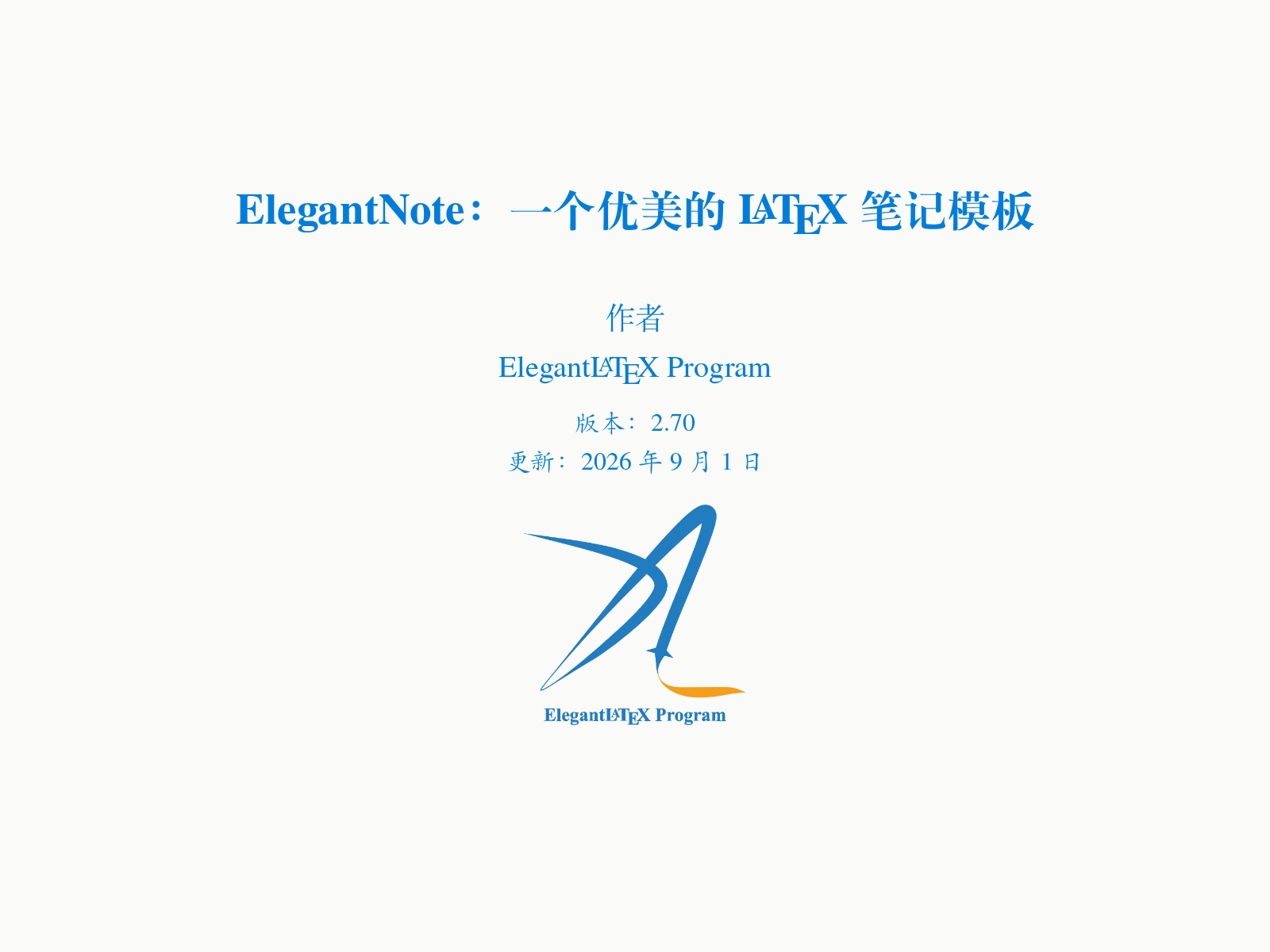
Open in LaTeX.to Download all files (zip)
elegantnote-cn.tex
\documentclass[cn,hazy,blue,14pt,screen]{elegantnote}
\title{ElegantNote:一个优美的 \LaTeX\ 笔记模板}

\author{作者}
\institute{Elegant\LaTeX\ Program}

\version{2.70}
\date{\zhdate{2026/9/1}}

\usepackage{array}

\addbibresource[location=local]{reference.bib}

\begin{document}

\maketitle

\centerline{
  \includegraphics[width=0.2\textwidth]{logo-blue.png}
}

\section{ElegantNote 使用说明}

\textbf{\textcolor{red}{\bfseries 本模板自 2023 年 1 月 1 日起停止维护,并不建议使用,但鉴于用户群体庞大,自 2026 年起重新发布。为保证之前版本的用户仍能查阅说明文档,本说明文档保留了过往信息。}}

新版 ElegantNote 是基于标准的 \LaTeX\ 文类 article 重新设计的,格式更加简化的笔记模板!本模板支持两种编译方式,\hologo{pdfLaTeX} 和 \hologo{XeLaTeX},英文模式下请使用 \hologo{pdfLaTeX} 进行编译,中文模式下务必使用 \hologo{XeLaTeX}。

新模板有下面几个特性:

\begin{itemize}
  \item 纸张模式:护眼模式(geye)和朦胧模式(hazy);
  \item 适配不同设备,包括 Pad(默认),Screen(幻灯片),Kindle,PC(双页),通用(A4 纸张);
  \item 5 套颜色主题,分别是:\textcolor{eblue}{blue}(默认)、\textcolor{egreen}{green}、\textcolor{ecyan}{cyan}、 \textcolor{sakura}{sakura} 和 \textcolor{black}{black};
  \item 语言支持:中文(默认),英文;
  \item 支持 \hologo{pdfLaTeX} 和 \hologo{XeLaTeX} 编译;
  \item 更加美观的图表标题格式,列表环境,数学字体等;
  \item 全局字体大小支持:8pt, 9pt, 10pt, 11pt, 12pt, 14pt, 17pt, 和 20pt;
  \item 支持 \lstinline{newtx} 以及 \lstinline{mtpro2} 数学字体设置;
  \item 中文字体支持方正字体或者自定义字体;
  \item 英文模式通过 \lstinline{bibstyle} 选项(默认为 \lstinline{apalike})支持参考文献格式修改;
  \item 支持参考格式显示格式修改 \lstinline{cite} 可选为 \lstinline{authoryear}、\lstinline{numbers} (默认)和 \lstinline{super}。
\end{itemize}

\subsection{模板模式}

本模板增加了模式选项,分别有护眼模式(\lstinline{mode=geye})和朦胧模式(\lstinline{mode=hazy})。其中护眼模式设置纸张底色为绿豆沙颜色,而朦胧模式为淡蓝色,开启的方法如下:
\begin{lstlisting}[frame=none]
  \documentclass[geye]{elegantnote} % or
  \documentclass[mode=geye]{elegantnote}
  \documentclass[hazy]{elegantnote} % or
  \documentclass[mode=hazy]{elegantnote}
\end{lstlisting}

\begin{remark}
  如果你想为自己的文档添加底色,可以在导言区添加下面设置:
  \begin{lstlisting}
    \definecolor{geyecolor}{RGB}{199,237,204}
    \pagecolor{geyecolor}
  \end{lstlisting}
\end{remark}


\subsection{设备选择}

为了让笔记方便在不同设备上阅读,免去切边,缩放等操作,本模板适配不同的设备,分别为 Pad(默认),Kindle,PC,A4。

\textcolor{red}{\kaishu 新增}:为了方便展示笔记,2.20 版本新增了 \lstinline{device=screen} 设备选项,大小为 MS Powerpoint 的纸张大小,比例为 4:3(2019/12/06)。

不同屏幕的选择为
\begin{lstlisting}[frame=none]
  \documentclass[device=pad]{elegantnote}    % ipad screen size
  \documentclass[device=kindle]{elegantnote} % kindle screen size
  \documentclass[device=pc]{elegantnote}     % double pages for pc
  \documentclass[device=normal]{elegantnote} % a4 normal page
  \documentclass[device=screen]{elegantnote} % 4:3 PPT size
\end{lstlisting}
\begin{note}
也可以采取直接赋值的方法选择屏幕,比如:
\end{note}
\begin{lstlisting}[frame=none]
  \documentclass[pad]{elegantnote}
  \documentclass[kindle]{elegantnote}
  \documentclass[pc]{elegantnote}
  \documentclass[normal]{elegantnote}
  \documentclass[screen]{elegantnote}
\end{lstlisting}

\begin{note}
  如果想要正常的 A4 大小的 PDF,需要选择 \lstinline{device=normal}。
\end{note}


\subsection{数学字体选项}

本模板定义了一个数学字体选项(\lstinline{math}),可选项有三个:
\begin{enumerate}
  \item \lstinline{math=cm}(默认),使用 \LaTeX\ 默认数学字体(推荐,无需声明);
  \item \lstinline{math=newtx},使用 \lstinline{newtxmath} 设置数学字体(潜在问题比较多)。
  \item \lstinline{math=mtpro2},使用 \lstinline{mtpro2} 宏包设置数学字体,要求用户已经成功安装此宏包。
\end{enumerate}


\subsection{中文字体选项}
模板提供中文字体选项 \lstinline{chinesefont},可选项有
\begin{enumerate}
\item \lstinline{ctexfont}:默认选项,使用 \lstinline{ctex} 宏包根据系统自行选择字体,可能存在字体缺失的问题,更多内容参考 \lstinline{ctex} 宏包\href{https://ctan.org/pkg/ctex}{官方文档}\footnote{可以使用命令提示符,输入 \lstinline{texdoc ctex} 调出本地 \lstinline{ctex} 宏包文档}。
\item \lstinline{founder}:方正字体选项(需要用户安装字体),调用 \lstinline{ctex} 宏包并且使用 \lstinline{fontset=none} 选项,然后设置字体为方正四款免费字体,方正字体下载注意事项见后文。
\item \lstinline{nofont}:调用 \lstinline{ctex} 宏包并且使用 \lstinline{fontset=none} 选项,不设定中文字体,用户可以自行设置中文字体,具体见后文。
\end{enumerate}

\noindent \textbf{注意:} 使用 \lstinline{founder} 选项或者 \lstinline{nofont} 时,必须使用 \hologo{XeLaTeX} 进行编译。

\subsubsection{方正字体选项}
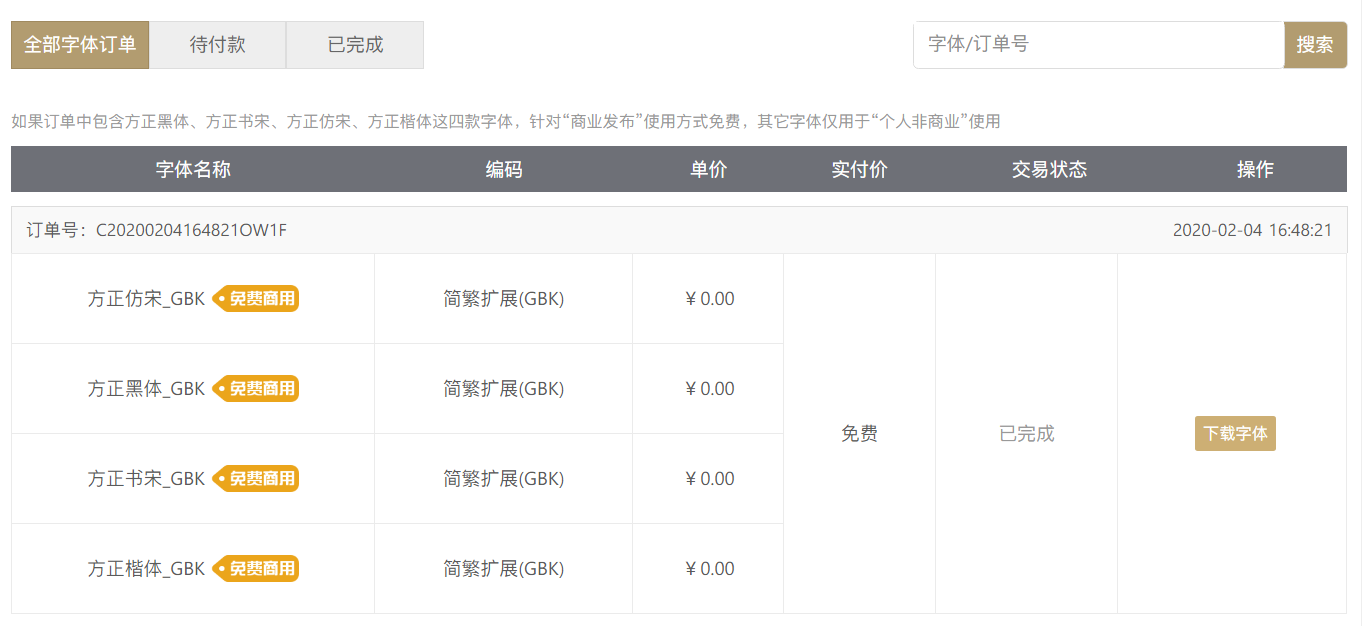
由于使用 \lstinline{ctex} 宏包默认调用系统已有的字体,部分系统字体缺失严重,因此,用户希望能够使用其它字体,我们推荐使用方正字体。方正的{\songti 方正书宋}、{\heiti 方正黑体}、{\kaishu 方正楷体}、{\fangsong 方正仿宋}四款字体均可免费试用,且可用于商业用途。用户可以自行从\href{http://www.foundertype.com/}{方正字体官网}下载此四款字体,在下载的时候请\textbf{务必}注意选择 GBK 字符集。安装时,{\kaishu Windows 11 用户请右键选择为全部用户安装,否则会找不到字体。}

\begin{figure}[!htb]
\centering
\includegraphics[width=0.9\textwidth]{founder.png}
\end{figure}

\subsubsection{其他中文字体}
如果你想完全自定义字体\footnote{这里仍然以方正字体为例。},你可以选择 \lstinline{chinesefont=nofont},然后在导言区设置,参考代码如下:
\begin{lstlisting}
  \setCJKmainfont[BoldFont={FZHei-B01},ItalicFont={FZKai-Z03}]{FZShuSong-Z01}
  \setCJKsansfont[BoldFont={FZHei-B01}]{FZKai-Z03}
  \setCJKmonofont[BoldFont={FZHei-B01}]{FZFangSong-Z02}
  \setCJKfamilyfont{zhsong}{FZShuSong-Z01}
  \setCJKfamilyfont{zhhei}{FZHei-B01}
  \setCJKfamilyfont{zhkai}[BoldFont={FZHei-B01}]{FZKai-Z03}
  \setCJKfamilyfont{zhfs}[BoldFont={FZHei-B01}]{FZFangSong-Z02}
  \newcommand*{\songti}{\CJKfamily{zhsong}}
  \newcommand*{\heiti}{\CJKfamily{zhhei}}
  \newcommand*{\kaishu}{\CJKfamily{zhkai}}
  \newcommand*{\fangsong}{\CJKfamily{zhfs}}
\end{lstlisting}


\subsection[颜色主题]{颜色主题\footnote{测试章节脚注。}}

本模板内置 5 套颜色主题,分别是 \textcolor{eblue}{blue}(默认),\textcolor{egreen}{green}, \textcolor{ecyan}{cyan}, \textcolor{sakura}{sakura} 和 \textcolor{black}{black}。如果不需要颜色,可以选择黑色(black)主题。颜色主题的设置方法:
\begin{lstlisting}[frame=none]
  \documentclass[green]{elegantnote}
  \documentclass[color=green]{elegantnote}
  ...
  \documentclass[black]{elegantnote}
  \documentclass[color=black]{elegantnote}
\end{lstlisting}


\subsection{语言模式}

本模板内含两套语言环境,改变语言环境会改变图表标题的引导词(图,表),文章结构词(比如目录,参考文献等),以及定理环境中的引导词(比如定理,引理等)。不同语言模式的启用如下:
\begin{lstlisting}[frame=none]
  \documentclass[cn]{elegantnote}
  \documentclass[lang=cn]{elegantnote}
  \documentclass[en]{elegantnote}
  \documentclass[lang=en]{elegantnote}
\end{lstlisting}

\begin{note}
只有中文模式才可输入中文,如果需要在英文模式下输入中文,可以自行添加 \lstinline{ctex} 宏包\footnote{需要使用 \lstinline{scheme=plain} 选项才不会把标题改为中文。}或者使用 \lstinline{xeCJK} 宏包设置字体。另外如果在笔记中使用了抄录环境(\lstinline{lstlisting}),并且里面有中文字符,请务必使用 \hologo{XeLaTeX} 编译。
\end{note}


\subsection{定理类环境}

此模板采用了 \lstinline{amsthm} 中的定理样式,使用了 4 类定理样式,所包含的环境分别为
\begin{itemize}
  \item \textbf{定理类}:theorem,lemma,proposition,corollary;
  \item \textbf{定义类}:definition,conjecture,example;
  \item \textbf{备注类}:remark,note,case;
  \item \textbf{证明类}:proof。
\end{itemize}

\begin{remark}
在选用 \lstinline{lang=cn} 时,定理类环境的引导词全部会改为中文。
\end{remark}


\section{写作示例}

我们将通过三个步骤定义可测函数的积分。首先定义非负简单函数的积分。以下设 $E$ 是 $\mathcal{R}^n$ 中的可测集。

\begin{definition}[可积性]
设 $ f(x)=\sum\limits_{i=1}^{k} a_i \chi_{A_i}(x)$ 是 $E$ 上的非负简单函数,其中 $\{A_1,A_2,\ldots$, $A_k\}$ 是 $E$ 上的一个可测分割,$a_1,a_2,\ldots,a_k$ 是非负实数。定义 $f$ 在 $E$ 上的积分为 1. 3
\begin{equation}
   \label{inter}
   \int_{E} f dx = \sum_{i=1}^k a_i m(A_i).
\end{equation}
一般情况下 $0 \leq \int_{E} f dx \leq \infty$。若 $\int_{E} f dx < \infty$,则称 $f$ 在 $E$ 上可积。
\end{definition}

一个自然的问题是,Lebesgue 积分与我们所熟悉的 Riemann 积分有什么联系和区别?之后我们将详细讨论 Riemann 积分与 Lebesgue 积分的关系。这里只看一个简单的例子。设 $D(x)$ 是区间 $[0,1]$ 上的 Dirichlet 函数。即 $D(x)=\chi_{Q_0}(x)$,其中 $Q_0$ 表示 $[0,1]$ 中的有理数的全体。根据非负简单函数积分的定义,$D(x)$ 在 $[0,1]$ 上的 Lebesgue 积分为
\begin{equation}\label{inter2}
  \int_0^1 D(x)dx = \int_0^1 \chi_{Q_0} (x) dx = m(Q_0) = 0
\end{equation}
即 $D(x)$ 在 $[0,1]$ 上是 Lebesgue 可积的并且积分值为零。但 $D(x)$ 在 $[0,1]$ 上不是 Riemann 可积的。

\begin{table}[htbp]
  \centering
  \small
  \caption{燃油效率与汽车价格}
    \begin{tabular}{lcc}
    \toprule
                  &       (1)         &        (2)      \\
    \midrule
    燃油效率      &   -238.90***      &      -49.51     \\
                  &    (53.08)        &      (86.16)    \\
    汽车重量      &                   &        1.75***  \\
                  &                   &       (0.641)   \\
    常数项        &  11253.00***      &    1946.00      \\
                  &  (1171.00)        &   (3597.00)     \\
    观测数        &     74            &      74         \\
    $R^2$         &      0.220        &       0.293     \\
    \bottomrule
    \end{tabular}%
  \label{tab:reg}%
\end{table}%

\begin{theorem}[Fubini 定理]\label{thm:fubi}
若 $f(x,y)$ 是 $\mathcal{R}^p\times\mathcal{R}^q$ 上的非负可测函数,则对几乎处处的 $x\in \mathcal{R}^p$,$f(x,y)$ 作为 $y$ 的函数是 $\mathcal{R}^q$ 上的非负可测函数,$g(x)=\int_{\mathcal{R}^q}f(x,y) dy$ 是 $\mathcal{R}^p$ 上的非负可测函数。并且
\begin{equation}\label{eq:461}
  \int_{\mathcal{R}^p\times\mathcal{R}^q} f(x,y) dxdy=\int_{\mathcal{R}^p}\left(\int_{\mathcal{R}^q}f(x,y)dy\right)dx.
\end{equation}
\end{theorem}

\begin{proof}
Let $z$ be some element of $xH \cap yH$.  Then $z = xa$ for some $a \in H$, and $z = yb$ for some $b \in H$. If $h$ is any element of $H$ then $ah \in H$ and $a^{-1}h \in H$, since $H$ is a subgroup of $G$. But $zh = x(ah)$ and $xh = z(a^{-1}h)$ for all $h \in H$. Therefore $zH \subset xH$ and $xH \subset zH$, and thus $xH = zH$.  Similarly $yH = zH$, and thus $xH = yH$, as required.
\end{proof}


回归分析(regression analysis) 是确定两种或两种以上变量间相互依赖的定量关系的一种统计分析方法。根据定理~\ref{thm:fubi},其运用十分广泛,回归分析按照涉及的变量的多少,分为一元回归和多元回归分析;按照因变量的多少,可分为简单回归分析和多重回归分析;按照自变量和因变量之间的关系类型,可分为线性回归分析和非线性回归分析。


\section{致谢}

特别感谢 \href{https://github.com/sikouhjw}{sikouhjw} 和 \href{https://github.com/syvshc}{syvshc}  长期以来对于 Github 上 issue 的快速回应,以及各个社区论坛对于 Elegant\LaTeX\ 相关问题的回复。特别感谢 China\TeX\ 以及 \href{http://www.latexstudio.net/}{\LaTeX\ 工作室} 对于本系列模板的宣传与推广。

如果你喜欢我们的模板,你可以在 Github 上收藏我们的模板。

\section{常见问题 FAQ}

\begin{enumerate}[label=\arabic*).]
  \item \textit{如何删除版本信息?}\\
    导言区不写 \lstinline|\version{x.xx}| 即可。
  \item \textit{如何删除日期?}\\
    与版本 \lstinline{\version} 不同的是,导言区不写或注释 \lstinline{\date} 的话,仍然会打印出当日日期,原因是 \lstinline{\date} 有默认参数。如果不需要日期的话,日期可以留空即可,也即 \lstinline|\date{}|。
  \item \textit{如何获得中文日期?}\\
    为了获得中文日期,必须在中文模式下,使用 \lstinline|\date{\zhdate{2019/12/09}}|,如果需要当天的汉化日期,可以使用 \lstinline|\date{\zhtoday}|,这两个命令都来源于 \href{https://ctan.org/pkg/zhnumber}{\lstinline{zhnumber}} 宏包。
  \item \textit{如何添加多个作者?}\\
    在 \lstinline{\author} 里面使用 \lstinline{\and},作者单位可以用 \lstinline{\\} 换行。
    \begin{lstlisting}
      \author{author 1\\ org. 1 \and author 2 \\ org. 2 }
    \end{lstlisting}
\end{enumerate}

%\printbibliography[heading=bibintoc, title=\ebibname]

\end{document}
image/logo-blue.png

image/founder.png
License
The LaTeX Project Public License
=-=-=-=-=-=-=-=-=-=-=-=-=-=-=-=-

LPPL Version 1.3c  2008-05-04

Copyright 1999 2002-2008 LaTeX3 Project
    Everyone is allowed to distribute verbatim copies of this
    license document, but modification of it is not allowed.


PREAMBLE
========

The LaTeX Project Public License (LPPL) is the primary license under
which the LaTeX kernel and the base LaTeX packages are distributed.

You may use this license for any work of which you hold the copyright
and which you wish to distribute.  This license may be particularly
suitable if your work is TeX-related (such as a LaTeX package), but
it is written in such a way that you can use it even if your work is
unrelated to TeX.

The section `WHETHER AND HOW TO DISTRIBUTE WORKS UNDER THIS LICENSE',
below, gives instructions, examples, and recommendations for authors
who are considering distributing their works under this license.

This license gives conditions under which a work may be distributed
and modified, as well as conditions under which modified versions of
that work may be distributed.

We, the LaTeX3 Project, believe that the conditions below give you
the freedom to make and distribute modified versions of your work
that conform with whatever technical specifications you wish while
maintaining the availability, integrity, and reliability of
that work.  If you do not see how to achieve your goal while
meeting these conditions, then read the document `cfgguide.tex'
and `modguide.tex' in the base LaTeX distribution for suggestions.


DEFINITIONS
===========

In this license document the following terms are used:

   `Work'
    Any work being distributed under this License.

   `Derived Work'
    Any work that under any applicable law is derived from the Work.

   `Modification'
    Any procedure that produces a Derived Work under any applicable
    law -- for example, the production of a file containing an
    original file associated with the Work or a significant portion of
    such a file, either verbatim or with modifications and/or
    translated into another language.

   `Modify'
    To apply any procedure that produces a Derived Work under any
    applicable law.

   `Distribution'
    Making copies of the Work available from one person to another, in
    whole or in part.  Distribution includes (but is not limited to)
    making any electronic components of the Work accessible by
    file transfer protocols such as FTP or HTTP or by shared file
    systems such as Sun's Network File System (NFS).

   `Compiled Work'
    A version of the Work that has been processed into a form where it
    is directly usable on a computer system.  This processing may
    include using installation facilities provided by the Work,
    transformations of the Work, copying of components of the Work, or
    other activities.  Note that modification of any installation
    facilities provided by the Work constitutes modification of the Work.

   `Current Maintainer'
    A person or persons nominated as such within the Work.  If there is
    no such explicit nomination then it is the `Copyright Holder' under
    any applicable law.

   `Base Interpreter'
    A program or process that is normally needed for running or
    interpreting a part or the whole of the Work.

    A Base Interpreter may depend on external components but these
    are not considered part of the Base Interpreter provided that each
    external component clearly identifies itself whenever it is used
    interactively.  Unless explicitly specified when applying the
    license to the Work, the only applicable Base Interpreter is a
    `LaTeX-Format' or in the case of files belonging to the
    `LaTeX-format' a program implementing the `TeX language'.


CONDITIONS ON DISTRIBUTION AND MODIFICATION
===========================================

1.  Activities other than distribution and/or modification of the Work
are not covered by this license; they are outside its scope.  In
particular, the act of running the Work is not restricted and no
requirements are made concerning any offers of support for the Work.

2.  You may distribute a complete, unmodified copy of the Work as you
received it.  Distribution of only part of the Work is considered
modification of the Work, and no right to distribute such a Derived
Work may be assumed under the terms of this clause.

3.  You may distribute a Compiled Work that has been generated from a
complete, unmodified copy of the Work as distributed under Clause 2
above, as long as that Compiled Work is distributed in such a way that
the recipients may install the Compiled Work on their system exactly
as it would have been installed if they generated a Compiled Work
directly from the Work.

4.  If you are the Current Maintainer of the Work, you may, without
restriction, modify the Work, thus creating a Derived Work.  You may
also distribute the Derived Work without restriction, including
Compiled Works generated from the Derived Work.  Derived Works
distributed in this manner by the Current Maintainer are considered to
be updated versions of the Work.

5.  If you are not the Current Maintainer of the Work, you may modify
your copy of the Work, thus creating a Derived Work based on the Work,
and compile this Derived Work, thus creating a Compiled Work based on
the Derived Work.

6.  If you are not the Current Maintainer of the Work, you may
distribute a Derived Work provided the following conditions are met
for every component of the Work unless that component clearly states
in the copyright notice that it is exempt from that condition.  Only
the Current Maintainer is allowed to add such statements of exemption
to a component of the Work.

  a. If a component of this Derived Work can be a direct replacement
     for a component of the Work when that component is used with the
     Base Interpreter, then, wherever this component of the Work
     identifies itself to the user when used interactively with that
     Base Interpreter, the replacement component of this Derived Work
     clearly and unambiguously identifies itself as a modified version
     of this component to the user when used interactively with that
     Base Interpreter.

  b. Every component of the Derived Work contains prominent notices
     detailing the nature of the changes to that component, or a
     prominent reference to another file that is distributed as part
     of the Derived Work and that contains a complete and accurate log
     of the changes.

  c. No information in the Derived Work implies that any persons,
     including (but not limited to) the authors of the original version
     of the Work, provide any support, including (but not limited to)
     the reporting and handling of errors, to recipients of the
     Derived Work unless those persons have stated explicitly that
     they do provide such support for the Derived Work.

  d. You distribute at least one of the following with the Derived Work:

       1. A complete, unmodified copy of the Work;
          if your distribution of a modified component is made by
          offering access to copy the modified component from a
          designated place, then offering equivalent access to copy
          the Work from the same or some similar place meets this
          condition, even though third parties are not compelled to
          copy the Work along with the modified component;

       2. Information that is sufficient to obtain a complete,
          unmodified copy of the Work.

7.  If you are not the Current Maintainer of the Work, you may
distribute a Compiled Work generated from a Derived Work, as long as
the Derived Work is distributed to all recipients of the Compiled
Work, and as long as the conditions of Clause 6, above, are met with
regard to the Derived Work.

8.  The conditions above are not intended to prohibit, and hence do not
apply to, the modification, by any method, of any component so that it
becomes identical to an updated version of that component of the Work as
it is distributed by the Current Maintainer under Clause 4, above.

9.  Distribution of the Work or any Derived Work in an alternative
format, where the Work or that Derived Work (in whole or in part) is
then produced by applying some process to that format, does not relax or
nullify any sections of this license as they pertain to the results of
applying that process.

10. a. A Derived Work may be distributed under a different license
       provided that license itself honors the conditions listed in
       Clause 6 above, in regard to the Work, though it does not have
       to honor the rest of the conditions in this license.

    b. If a Derived Work is distributed under a different license, that
       Derived Work must provide sufficient documentation as part of
       itself to allow each recipient of that Derived Work to honor the
       restrictions in Clause 6 above, concerning changes from the Work.

11. This license places no restrictions on works that are unrelated to
the Work, nor does this license place any restrictions on aggregating
such works with the Work by any means.

12.  Nothing in this license is intended to, or may be used to, prevent
complete compliance by all parties with all applicable laws.


NO WARRANTY
===========

There is no warranty for the Work.  Except when otherwise stated in
writing, the Copyright Holder provides the Work `as is', without
warranty of any kind, either expressed or implied, including, but not
limited to, the implied warranties of merchantability and fitness for a
particular purpose.  The entire risk as to the quality and performance
of the Work is with you.  Should the Work prove defective, you assume
the cost of all necessary servicing, repair, or correction.

In no event unless required by applicable law or agreed to in writing
will The Copyright Holder, or any author named in the components of the
Work, or any other party who may distribute and/or modify the Work as
permitted above, be liable to you for damages, including any general,
special, incidental or consequential damages arising out of any use of
the Work or out of inability to use the Work (including, but not limited
to, loss of data, data being rendered inaccurate, or losses sustained by
anyone as a result of any failure of the Work to operate with any other
programs), even if the Copyright Holder or said author or said other
party has been advised of the possibility of such damages.


MAINTENANCE OF THE WORK
=======================

The Work has the status `author-maintained' if the Copyright Holder
explicitly and prominently states near the primary copyright notice in
the Work that the Work can only be maintained by the Copyright Holder
or simply that it is `author-maintained'.

The Work has the status `maintained' if there is a Current Maintainer
who has indicated in the Work that they are willing to receive error
reports for the Work (for example, by supplying a valid e-mail
address). It is not required for the Current Maintainer to acknowledge
or act upon these error reports.

The Work changes from status `maintained' to `unmaintained' if there
is no Current Maintainer, or the person stated to be Current
Maintainer of the work cannot be reached through the indicated means
of communication for a period of six months, and there are no other
significant signs of active maintenance.

You can become the Current Maintainer of the Work by agreement with
any existing Current Maintainer to take over this role.

If the Work is unmaintained, you can become the Current Maintainer of
the Work through the following steps:

 1.  Make a reasonable attempt to trace the Current Maintainer (and
     the Copyright Holder, if the two differ) through the means of
     an Internet or similar search.

 2.  If this search is successful, then enquire whether the Work
     is still maintained.

  a. If it is being maintained, then ask the Current Maintainer
     to update their communication data within one month.

  b. If the search is unsuccessful or no action to resume active
     maintenance is taken by the Current Maintainer, then announce
     within the pertinent community your intention to take over
     maintenance.  (If the Work is a LaTeX work, this could be
     done, for example, by posting to comp.text.tex.)

 3a. If the Current Maintainer is reachable and agrees to pass
     maintenance of the Work to you, then this takes effect
     immediately upon announcement.

  b. If the Current Maintainer is not reachable and the Copyright
     Holder agrees that maintenance of the Work be passed to you,
     then this takes effect immediately upon announcement.

 4.  If you make an `intention announcement' as described in 2b. above
     and after three months your intention is challenged neither by
     the Current Maintainer nor by the Copyright Holder nor by other
     people, then you may arrange for the Work to be changed so as
     to name you as the (new) Current Maintainer.

 5.  If the previously unreachable Current Maintainer becomes
     reachable once more within three months of a change completed
     under the terms of 3b) or 4), then that Current Maintainer must
     become or remain the Current Maintainer upon request provided
     they then update their communication data within one month.

A change in the Current Maintainer does not, of itself, alter the fact
that the Work is distributed under the LPPL license.

If you become the Current Maintainer of the Work, you should
immediately provide, within the Work, a prominent and unambiguous
statement of your status as Current Maintainer.  You should also
announce your new status to the same pertinent community as
in 2b) above.


WHETHER AND HOW TO DISTRIBUTE WORKS UNDER THIS LICENSE
======================================================

This section contains important instructions, examples, and
recommendations for authors who are considering distributing their
works under this license.  These authors are addressed as `you' in
this section.

Choosing This License or Another License
----------------------------------------

If for any part of your work you want or need to use *distribution*
conditions that differ significantly from those in this license, then
do not refer to this license anywhere in your work but, instead,
distribute your work under a different license.  You may use the text
of this license as a model for your own license, but your license
should not refer to the LPPL or otherwise give the impression that
your work is distributed under the LPPL.

The document `modguide.tex' in the base LaTeX distribution explains
the motivation behind the conditions of this license.  It explains,
for example, why distributing LaTeX under the GNU General Public
License (GPL) was considered inappropriate.  Even if your work is
unrelated to LaTeX, the discussion in `modguide.tex' may still be
relevant, and authors intending to distribute their works under any
license are encouraged to read it.

A Recommendation on Modification Without Distribution
-----------------------------------------------------

It is wise never to modify a component of the Work, even for your own
personal use, without also meeting the above conditions for
distributing the modified component.  While you might intend that such
modifications will never be distributed, often this will happen by
accident -- you may forget that you have modified that component; or
it may not occur to you when allowing others to access the modified
version that you are thus distributing it and violating the conditions
of this license in ways that could have legal implications and, worse,
cause problems for the community.  It is therefore usually in your
best interest to keep your copy of the Work identical with the public
one.  Many works provide ways to control the behavior of that work
without altering any of its licensed components.

How to Use This License
-----------------------

To use this license, place in each of the components of your work both
an explicit copyright notice including your name and the year the work
was authored and/or last substantially modified.  Include also a
statement that the distribution and/or modification of that
component is constrained by the conditions in this license.

Here is an example of such a notice and statement:

  %% pig.dtx
  %% Copyright 2005 M. Y. Name
  %
  % This work may be distributed and/or modified under the
  % conditions of the LaTeX Project Public License, either version 1.3
  % of this license or (at your option) any later version.
  % The latest version of this license is in
  %   http://www.latex-project.org/lppl.txt
  % and version 1.3 or later is part of all distributions of LaTeX
  % version 2005/12/01 or later.
  %
  % This work has the LPPL maintenance status `maintained'.
  %
  % The Current Maintainer of this work is M. Y. Name.
  %
  % This work consists of the files pig.dtx and pig.ins
  % and the derived file pig.sty.

Given such a notice and statement in a file, the conditions
given in this license document would apply, with the `Work' referring
to the three files `pig.dtx', `pig.ins', and `pig.sty' (the last being
generated from `pig.dtx' using `pig.ins'), the `Base Interpreter'
referring to any `LaTeX-Format', and both `Copyright Holder' and
`Current Maintainer' referring to the person `M. Y. Name'.

If you do not want the Maintenance section of LPPL to apply to your
Work, change `maintained' above into `author-maintained'.
However, we recommend that you use `maintained', as the Maintenance
section was added in order to ensure that your Work remains useful to
the community even when you can no longer maintain and support it
yourself.

Derived Works That Are Not Replacements
---------------------------------------

Several clauses of the LPPL specify means to provide reliability and
stability for the user community. They therefore concern themselves
with the case that a Derived Work is intended to be used as a
(compatible or incompatible) replacement of the original Work. If
this is not the case (e.g., if a few lines of code are reused for a
completely different task), then clauses 6b and 6d shall not apply.


Important Recommendations
-------------------------

 Defining What Constitutes the Work

   The LPPL requires that distributions of the Work contain all the
   files of the Work.  It is therefore important that you provide a
   way for the licensee to determine which files constitute the Work.
   This could, for example, be achieved by explicitly listing all the
   files of the Work near the copyright notice of each file or by
   using a line such as:

    % This work consists of all files listed in manifest.txt.

   in that place.  In the absence of an unequivocal list it might be
   impossible for the licensee to determine what is considered by you
   to comprise the Work and, in such a case, the licensee would be
   entitled to make reasonable conjectures as to which files comprise
   the Work.
How to use this template
Everything runs in your browser: nothing to install, no login, no compile timeout.
- Click Open in LaTeX.to. The template opens as a project in the Projects pane, with elegantnote-en.tex or elegantnote-cn.tex in the editor and its finished PDF in the preview.
- Click Preview, or press Ctrl+Enter (Cmd+Enter on a Mac), to compile. The preview shows the new PDF; you do not need to save first.
- If the compile fails, the Console pane opens with the LaTeX log. The first error in it says what went wrong and on which line.
- To add an image, a .bib file or another .tex file, open the project's menu (the three dots next to its name in the Projects pane) and choose Upload file or New file.
- The arrow next to Preview has Download PDF. Ctrl+S saves your edits, and the project stays in your browser on this device.
How to add a bibliography
The example names a reference.bib that the repository does not ship, so the first citation stops the compile until that file exists.
- Add a file named
reference.bibnext to the main file, the name in the\addbibresourceline, and put your entries in it. - Cite with
\cite{key}in the text. - Remove the
%in front of\printbibliographynear the end of the file. - For author and year citations, add
citestyle=authoryearandbibstyle=authoryearto the options in the first line. - biber runs by itself here.
How to get A4 or another page size
The example is sized for a 4:3 screen, and a4paper has no effect in this class.
- Replace
screenwithnormalin the first line for A4 with 1 inch margins. padgives 6 by 8 inches,kindle3.68 by 4.92 inches andpc6.2 by 6 inches.- For any other size, add a line such as
\geometry{paperwidth=25.4cm,paperheight=14.29cm}to the preamble, here a 16:9 slide.
How to add a table of contents
The example has no table of contents, and users ask how to add one and how to change its colors.
- Add
\tableofcontentson the line after\maketitle. - The entries are links in the theme color and the page numbers stay black.
- Add
\hypersetup{linktocpage=true}to the preamble to make the page numbers the links. - Add
\renewcommand*\contentsname{\centering Contents}to the preamble to center the heading.
How to add or change a theorem environment
Users ask for kinds the class does not have, such as a conclusion, and for definitions that are not in italics.
- Add
\theoremstyle{plain}and then\newtheorem{conclusion}{Conclusion}[section]to the preamble, whereConclusionis the word the heading prints. - Put the text between
\begin{conclusion}and\end{conclusion}. - Write
\newtheorem{conclusion}[theorem]{Conclusion}instead to number it in one row with the theorems and lemmas. - For upright definitions, conjectures and examples, add
\newtheoremstyle{definition}{\topsep}{\topsep}{\normalfont}{}{\color{ecolor}\bfseries}{}{0.5em}{}to the preamble. - In the Chinese version
\textbfhas no effect inside a theorem or a definition, because the Kai font has no bold: add\setCJKfamilyfont{zhkai}{FandolKai-Regular}[Extension=.otf,AutoFakeBold]to the preamble. \autorefprints the number alone, so write the name in a reference yourself, as inProposition \ref{prop:x}.
More templates: ThuThesis, SJTUThesis, latex-mimosis, novathesis, Dissertate and all templates.