LaTeX book template
A LaTeX book template for a book you plan to print, with the chapters in files of their own.
- Engine: pdfLaTeX
- License: Public domain, use freely.
Open in LaTeX.to Download all files (zip)
Files:
main.tex
\documentclass[11pt,a4paper]{book}

\usepackage[T1]{fontenc}
% Loaded last, so that it can hook into everything above it.
\usepackage[hidelinks]{hyperref}

\begin{document}

\frontmatter

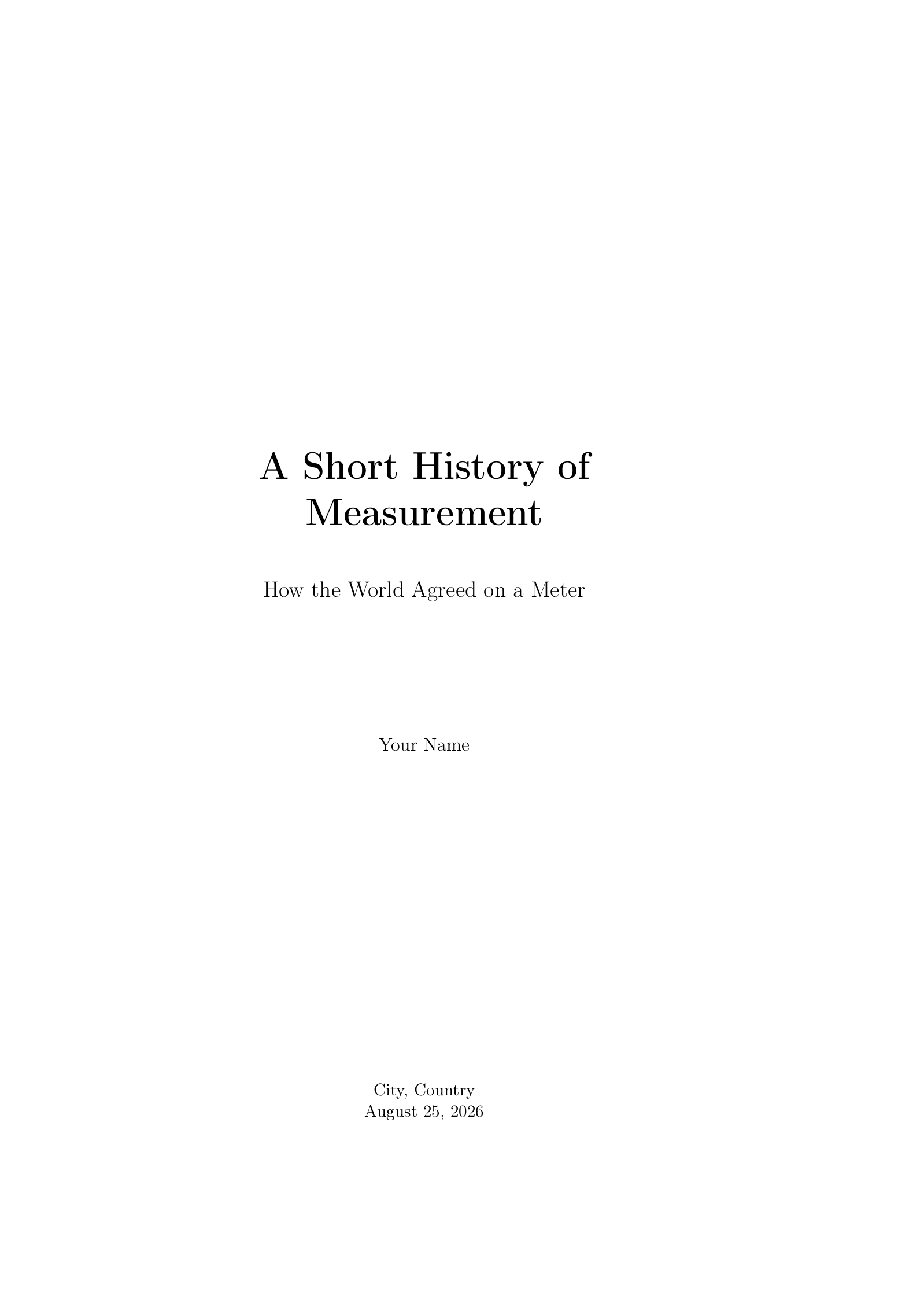
% Title page. Four lines to change: title, subtitle, author, place and date.
\begin{titlepage}
  \centering
  \vspace*{5cm}
  {\Huge\bfseries A Short History of Measurement\par}
  \vspace{1cm}
  {\Large How the World Agreed on a Meter\par}
  \vspace{3cm}
  {\large Your Name\par}
  \vfill
  {City, Country\par}
  {\today\par}
\end{titlepage}

% Dedication. Delete this page if you do not want one.
\cleardoublepage
\thispagestyle{empty}
\vspace*{7cm}
\begin{center}
  \emph{For everyone who has ever argued about a recipe.}
\end{center}
\cleardoublepage

\tableofcontents

\chapter*{Preface}
\addcontentsline{toc}{chapter}{Preface}

This book began with a kitchen scale that disagreed with a cookbook. The
cookbook was old, the scale was new, and the cup it asked for turned out to be
a different cup from the one in the cupboard. That is a small problem, and it
has a long history behind it.

The chapters that follow trace how measurement moved from the body and the
marketplace to a definition anyone can reproduce in a laboratory. It is a story
about surveying and metal bars, but it is mostly a story about agreement: who
gets to decide what a unit means, and what it costs everyone else when the
answer changes.

No mathematics beyond arithmetic is needed. Sources for the figures and the
quotations are listed at the back.

\mainmatter

\part{From the Body to the Meridian}

% One \input per chapter. Add a line here for every new file in chapters/.
\input{chapters/chapter1}
\input{chapters/chapter2}

\appendix

\chapter{Units mentioned in this book}

A short glossary of the units that appear in the chapters, with the values they
had where and when the text mentions them. Older units had no single value, so
each entry gives the range that historians usually quote.

\begin{description}
  \item[Cubit] The forearm, from the elbow to the tip of the middle finger.
    Roughly 44 to 53 centimeters, depending on the period and the place.
  \item[Foot] Roughly 28 to 34 centimeters. The Paris foot, the pied du roi,
    was about 32.5 centimeters.
  \item[Toise] Six Paris feet, about 1.95 meters. The unit the meridian survey
    was carried out in.
  \item[Meter] One ten millionth of the distance from the North Pole to the
    equator, as defined in 1791. Since 1983, the distance light travels in
    vacuum in one 299,792,458th of a second.
\end{description}

\backmatter

\begin{thebibliography}{9}
\addcontentsline{toc}{chapter}{Bibliography}

\bibitem{alder2002}
Ken Alder.
\emph{The Measure of All Things}.
Free Press, New York, 2002.

\bibitem{kula1986}
Witold Kula.
\emph{Measures and Men}.
Princeton University Press, Princeton, 1986.

\bibitem{bipm2019}
Bureau International des Poids et Mesures.
\emph{The International System of Units (SI)}.
Ninth edition, 2019.

\end{thebibliography}

\end{document}
chapters/chapter1.tex
Download chapters/chapter1.tex
\chapter{Measures Made of People}

Every old unit is a piece of somebody's body or somebody's working day. The
foot is a foot. The cubit is the forearm. The fathom is the span of two open
arms, which is exactly as far as a sailor can pull in one motion of rope. An
acre started out as the land a team of oxen could plow between sunrise and
sunset, so it was smaller on heavy clay and larger on light soil, and everyone
who worked the land thought that was perfectly reasonable.

\section{The body as a ruler}

A unit taken from the body has one enormous advantage: you always have it with
you. A carpenter with no ruler can still lay out a beam in feet, and a merchant
with no scale can still count an ell of cloth against an arm. For most of
recorded history, that convenience mattered more than agreement between one
town and the next.

The problem is that bodies differ. The usual answer was to average them. A
German handbook from the sixteenth century explains how to fix the length of a
rod: stop sixteen men as they leave church on a Sunday, tall ones and short
ones as they come, line up their left feet heel to toe, and call the result the
rod. It reads like a joke, and it is also a serious piece of statistics, four
hundred years before anyone used that word \cite{kula1986}.

Where averaging was not enough, communities made a physical standard and put it
somewhere public. Grain measures were cut into the stone of market halls.
Iron bars were set into church walls. Anyone who suspected a short measure
could walk over and check, which is a form of accountability that a printed
definition can never quite match.

\section{One market, one bushel}

Standards were about trade, and trade meant taxes, so rulers took an interest
early. Magna Carta, which is mostly remembered for other things, spends a
clause on measurement: there is to be one measure of wine throughout the realm,
one measure of ale, one measure of corn, and one width of cloth. That clause
was reissued, ignored, and reissued again for centuries, which tells you how
well it worked.

It kept failing because a unit was rarely just a quantity. A measure of grain
came with rules about whether the container was heaped or struck level, whether
the grain was poured from a height or set down gently, and who held the
straightedge. Each of those rules moved a few percent of the harvest from one
side of the transaction to the other. Changing the unit meant changing who ate
better that winter, and the people on the losing side understood this perfectly
well.

\section{Why the same word meant different things}

By the eighteenth century France had the same words in use nearly everywhere
and the same values almost nowhere. The pied, the aune, the setier, and the
arpent all existed in dozens of local versions, and a merchant traveling three
days by cart could pass through several of them. Historians who have tried to
count the distinct units in use before the revolution end up in the tens of
thousands.

For local business this was workable. Everyone in a market town knew the local
setier, and disputes had a local remedy. For anything larger it was a tax on
every transaction: contracts needed conversion clauses, and every conversion
was an opportunity for a quiet adjustment in someone's favor.

That is the situation the next chapter starts from. The interesting thing about
the reform that followed is not that somebody wanted uniform units. People had
wanted uniform units for five hundred years. It is that somebody found an
argument for a particular size that no town, guild, or king could claim as
their own.
chapters/chapter2.tex
Download chapters/chapter2.tex
\chapter{A Unit Taken from the Earth}

If a new unit is going to replace every old one, it has to come from somewhere
that nobody owns. The king's foot will not do, because the next king has a
different foot and the neighboring country has a king of its own. What the
reformers of the 1790s wanted was a length that any competent person could
recover from nature, without asking permission from anyone.

\section{The proposal of 1791}

Several candidates were on the table. One was the seconds pendulum, the length
of a pendulum that takes one second to swing. It is easy to reproduce and easy
to explain, and it has one flaw: the answer depends on where you stand, because
gravity is not the same everywhere. Choosing a latitude would have meant
choosing a country, and that was exactly the argument the commission was trying
to avoid.

The proposal that won, put to the National Assembly in 1791, took the unit from
the size of the planet instead. The meter would be one ten millionth of the
distance from the North Pole to the equator, measured along the meridian that
runs through Paris. The Earth belonged to everyone, or at least to nobody in
particular, and the definition could be stated in a sentence.

It also required somebody to go and measure the meridian, which is where the
trouble started \cite{alder2002}.

\section{Seven years between Dunkirk and Barcelona}

The survey was split between two astronomers. Jean Baptiste Joseph Delambre
took the northern arc from Dunkirk to Rodez, and Pierre M\'echain took the
southern arc from Rodez to Barcelona. Both worked by triangulation: pick two
points whose distance apart is known precisely, measure the angles to a third
point from each end, and the geometry gives you the two new distances. Repeat
across the country, chain of triangles by chain of triangles, and you have the
length of the arc.

The work was expected to take a year. It took seven. The two men were surveying
across a country at war, carrying brass instruments up church towers at night,
in a period when a stranger with a telescope and official papers was assumed to
be a spy. Both were detained more than once. Sightlines were blocked by weather
for weeks. M\'echain, stuck in Barcelona and later in Italy, could not get home
for years.

He also found a discrepancy. His latitude measurements at Barcelona did not
agree with each other as closely as his instruments should have allowed, and he
never resolved it. He hid the inconsistency, kept two sets of notes, and spent
the rest of his life trying to justify the number he had published. The story
was reconstructed from his papers long afterward, and it is the most human part
of the whole enterprise: the definition of the meter carries a small error that
one exhausted man could not bring himself to admit \cite{alder2002}.

The final number was deposited in 1799 as a platinum bar, the meter of the
Archives. Later work showed that the arc calculation had used a value for the
flattening of the Earth that was slightly off, so the bar came out about two
tenths of a millimeter shorter than the definition intended. Nobody has
proposed fixing it. By then the bar was the unit, and the definition had become
a historical note.

\section{From a bar to a constant}

Adoption was slower than the reformers hoped, including at home. France itself
went back to older units under Napoleon and only made the metric system
compulsory again in 1840. The international turn came in 1875, when seventeen
states signed the Metre Convention and set up a permanent bureau to hold the
standards and distribute copies. In 1889 a new international prototype, an
alloy of platinum and iridium with a cross section shaped like an X for
stiffness, replaced the bar from the Archives.

A metal bar is still an object. It can be dropped, it can corrode, and it has
to be compared against copies by people traveling to one building outside
Paris. The twentieth century replaced it twice. In 1960 the meter was redefined
as a number of wavelengths of orange red light from krypton 86, which any
properly equipped laboratory could reproduce. In 1983 it was tied to the speed
of light: the meter is the distance light travels in vacuum in one part in
299,792,458 of a second \cite{bipm2019}.

That last move is worth pausing on. The speed of light is no longer measured.
It is fixed by definition, and the meter follows from it. After two centuries,
the unit finally arrived where the commission of 1791 wanted it: available to
anyone, anywhere, without a trip to Paris and without asking a king.
How to use this template
Everything runs in your browser: nothing to install, no login, no compile timeout.
- Click Open in LaTeX.to. The template opens as a project in the Projects pane, with main.tex in the editor and its finished PDF in the preview.
- Click Preview, or press Ctrl+Enter (Cmd+Enter on a Mac), to compile. The preview shows the new PDF; you do not need to save first.
- If the compile fails, the Console pane opens with the LaTeX log. The first error in it says what went wrong and on which line.
- To add an image, a .bib file or another .tex file, open the project's menu (the three dots next to its name in the Projects pane) and choose Upload file or New file.
- The arrow next to Preview has Download PDF. Ctrl+S saves your edits, and the project stays in your browser on this device.
How to add a chapter
A chapter is one file in chapters/ and one line in main.tex.
- In the Projects pane, open the menu of the
chaptersfolder, choose New file and name itchapter3.tex. - Start the file with
\chapter{Title of the chapter}and write the text below it. - In
main.tex, add\input{chapters/chapter3}after the\input{chapters/chapter2}line, above\appendix.
How to remove the dedication page
The page after the title is a dedication, which not every book wants.
- In
main.tex, delete the lines from the% Dedicationcomment down to the\cleardoublepageafter\end{center}. - The table of contents then follows the title page directly.
How to change the page size
The file is A4, a reading size rather than a book size.
- For A5, change the first line to
\documentclass[11pt,a5paper]{book}. - For a six by nine inch paperback, add
\usepackage[paperwidth=6in,paperheight=9in,inner=0.9in,outer=0.7in]{geometry}below thefontencline; the inner margin is the wider one because the binding takes part of it. - Chapters open on a right hand page, as in a printed book; add
openanyto the class options to let them start on either page.
More templates: Article, Letter and all templates.