LaTeX cheat sheet template
A LaTeX cheat sheet template for the one page of formulas you are allowed to bring into an exam.
- Engine: pdfLaTeX
- License: Public domain, use freely.
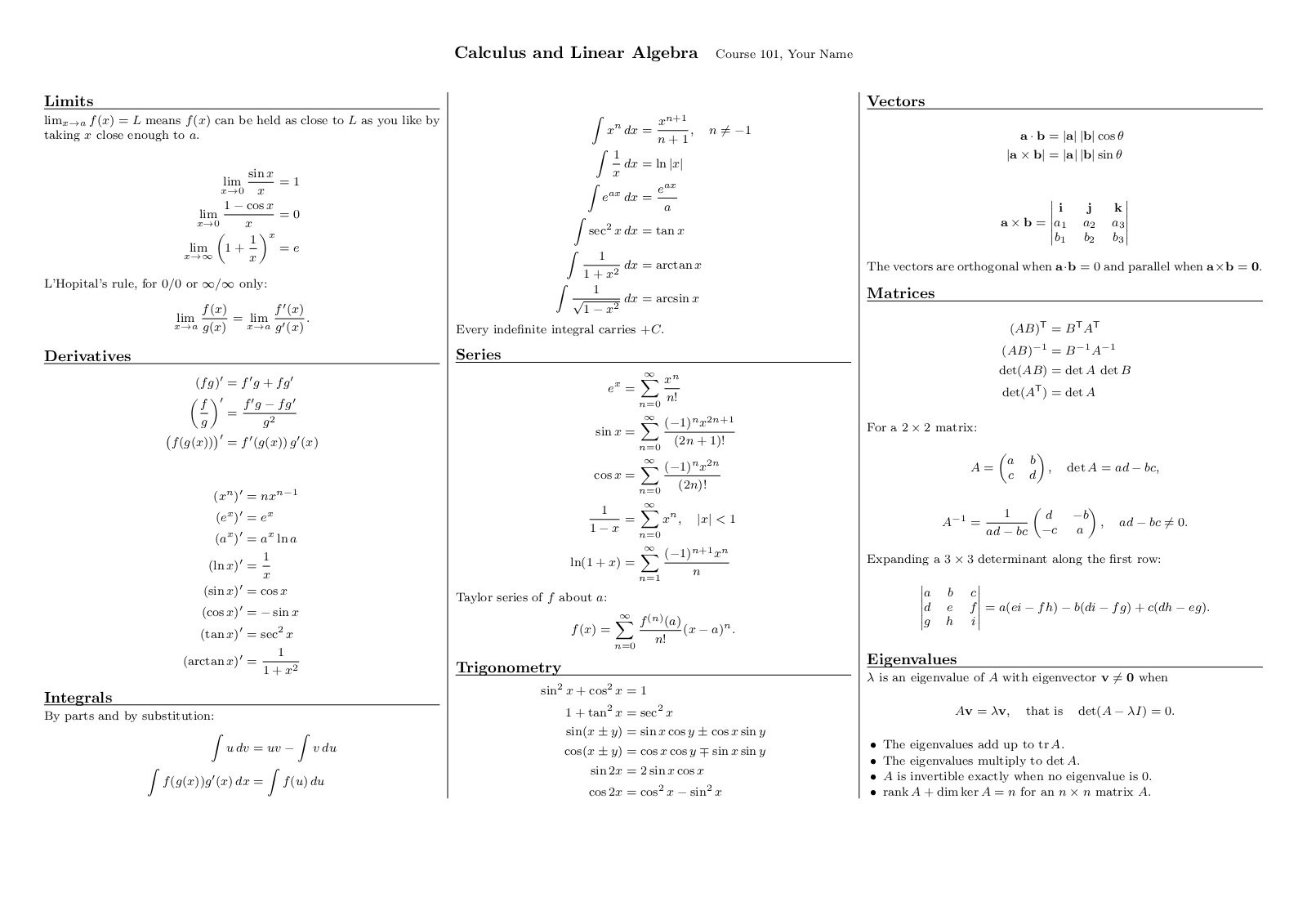
Open in LaTeX.to Download all files (zip)
Files:
main.tex
% Small type: extarticle is the article class with 8pt, 9pt, 14pt and more.
\documentclass[8pt]{extarticle}

% Landscape page with thin margins. Use portrait instead of landscape for an
% upright sheet, and change margin to get more or less room.
\usepackage[a4paper,landscape,margin=1cm]{geometry}
\usepackage{multicol}
\usepackage{amsmath}
\usepackage{amssymb}
\usepackage{enumitem}
\usepackage{titlesec}

% Tight headings: no space wasted above and below a section title.
\titleformat{\section}[block]{\large\bfseries}{}{0pt}{}[\vspace{-0.4ex}\titlerule]
\titlespacing*{\section}{0pt}{1.4ex plus 0.3ex}{0.7ex}

\setlength{\columnsep}{1.2em}
\setlength{\columnseprule}{0.4pt}
\setlength{\parindent}{0pt}
\setlength{\parskip}{0.4ex}
\setlist[itemize]{leftmargin=1.2em, topsep=0.3ex, itemsep=0.2ex, parsep=0pt}

\pagestyle{empty}

\begin{document}

\begin{center}
  {\Large\bfseries Calculus and Linear Algebra} \quad
  {\normalsize Course 101, Your Name}
\end{center}

\vspace{0.5ex}

% Three columns. Change the 3 to 2 or 4 for a different layout.
\begin{multicols}{3}

\section*{Limits}

$\lim_{x \to a} f(x) = L$ means $f(x)$ can be held as close to
$L$ as you like by taking $x$ close enough to $a$.

\begin{align*}
  \lim_{x \to 0} \frac{\sin x}{x} &= 1 \\
  \lim_{x \to 0} \frac{1 - \cos x}{x} &= 0 \\
  \lim_{x \to \infty} \left(1 + \frac{1}{x}\right)^{x} &= e
\end{align*}

L'Hopital's rule, for $0/0$ or $\infty/\infty$ only:
\[
  \lim_{x \to a} \frac{f(x)}{g(x)}
    = \lim_{x \to a} \frac{f'(x)}{g'(x)} .
\]

\section*{Derivatives}

\begin{align*}
  (fg)' &= f'g + fg' \\
  \left(\frac{f}{g}\right)' &= \frac{f'g - fg'}{g^2} \\
  \bigl(f(g(x))\bigr)' &= f'(g(x))\, g'(x)
\end{align*}

\begin{align*}
  (x^n)' &= n x^{n-1} \\
  (e^x)' &= e^x \\
  (a^x)' &= a^x \ln a \\
  (\ln x)' &= \frac{1}{x} \\
  (\sin x)' &= \cos x \\
  (\cos x)' &= -\sin x \\
  (\tan x)' &= \sec^2 x \\
  (\arctan x)' &= \frac{1}{1 + x^2}
\end{align*}

\section*{Integrals}

By parts and by substitution:
\begin{align*}
  \int u \, dv &= uv - \int v \, du \\
  \int f(g(x)) g'(x) \, dx &= \int f(u) \, du
\end{align*}

\begin{align*}
  \int x^n \, dx &= \frac{x^{n+1}}{n+1}, \quad n \neq -1 \\
  \int \frac{1}{x} \, dx &= \ln |x| \\
  \int e^{ax} \, dx &= \frac{e^{ax}}{a} \\
  \int \sec^2 x \, dx &= \tan x \\
  \int \frac{1}{1 + x^2} \, dx &= \arctan x \\
  \int \frac{1}{\sqrt{1 - x^2}} \, dx &= \arcsin x
\end{align*}

Every indefinite integral carries $+ C$.

\section*{Series}

\begin{align*}
  e^x &= \sum_{n=0}^{\infty} \frac{x^n}{n!} \\
  \sin x &= \sum_{n=0}^{\infty} \frac{(-1)^n x^{2n+1}}{(2n+1)!} \\
  \cos x &= \sum_{n=0}^{\infty} \frac{(-1)^n x^{2n}}{(2n)!} \\
  \frac{1}{1 - x} &= \sum_{n=0}^{\infty} x^n, \quad |x| < 1 \\
  \ln(1 + x) &= \sum_{n=1}^{\infty} \frac{(-1)^{n+1} x^n}{n}
\end{align*}

Taylor series of $f$ about $a$:
\[
  f(x) = \sum_{n=0}^{\infty} \frac{f^{(n)}(a)}{n!} (x - a)^n .
\]

\section*{Trigonometry}

\begin{align*}
  \sin^2 x + \cos^2 x &= 1 \\
  1 + \tan^2 x &= \sec^2 x \\
  \sin(x \pm y) &= \sin x \cos y \pm \cos x \sin y \\
  \cos(x \pm y) &= \cos x \cos y \mp \sin x \sin y \\
  \sin 2x &= 2 \sin x \cos x \\
  \cos 2x &= \cos^2 x - \sin^2 x
\end{align*}

\section*{Vectors}

\begin{align*}
  \mathbf{a} \cdot \mathbf{b}
    &= |\mathbf{a}| \, |\mathbf{b}| \cos \theta \\
  |\mathbf{a} \times \mathbf{b}|
    &= |\mathbf{a}| \, |\mathbf{b}| \sin \theta
\end{align*}

\[
  \mathbf{a} \times \mathbf{b} =
  \begin{vmatrix}
    \mathbf{i} & \mathbf{j} & \mathbf{k} \\
    a_1 & a_2 & a_3 \\
    b_1 & b_2 & b_3
  \end{vmatrix}
\]

The vectors are orthogonal when $\mathbf{a} \cdot \mathbf{b} = 0$ and
parallel when $\mathbf{a} \times \mathbf{b} = \mathbf{0}$.

\section*{Matrices}

\begin{align*}
  (AB)^{\mathsf{T}} &= B^{\mathsf{T}} A^{\mathsf{T}} \\
  (AB)^{-1} &= B^{-1} A^{-1} \\
  \det(AB) &= \det A \, \det B \\
  \det(A^{\mathsf{T}}) &= \det A
\end{align*}

For a $2 \times 2$ matrix:
\[
  A = \begin{pmatrix} a & b \\ c & d \end{pmatrix},
  \quad \det A = ad - bc,
\]
\[
  A^{-1} = \frac{1}{ad - bc}
    \begin{pmatrix} d & -b \\ -c & a \end{pmatrix},
    \quad ad - bc \neq 0 .
\]

Expanding a $3 \times 3$ determinant along the first row:
\[
  \begin{vmatrix}
    a & b & c \\ d & e & f \\ g & h & i
  \end{vmatrix}
  = a(ei - fh) - b(di - fg) + c(dh - eg) .
\]

\section*{Eigenvalues}

$\lambda$ is an eigenvalue of $A$ with eigenvector
$\mathbf{v} \neq \mathbf{0}$ when
\[
  A \mathbf{v} = \lambda \mathbf{v},
  \quad \text{that is} \quad
  \det(A - \lambda I) = 0 .
\]

\begin{itemize}
  \item The eigenvalues add up to $\operatorname{tr} A$.
  \item The eigenvalues multiply to $\det A$.
  \item $A$ is invertible exactly when no eigenvalue is $0$.
  \item $\operatorname{rank} A + \dim \ker A = n$ for an
        $n \times n$ matrix $A$.
\end{itemize}

\end{multicols}

\end{document}
How to use this template
Everything runs in your browser: nothing to install, no login, no compile timeout.
- Click Open in LaTeX.to. The template opens as a project in the Projects pane, with main.tex in the editor and its finished PDF in the preview.
- Click Preview, or press Ctrl+Enter (Cmd+Enter on a Mac), to compile. The preview shows the new PDF; you do not need to save first.
- If the compile fails, the Console pane opens with the LaTeX log. The first error in it says what went wrong and on which line.
- To add an image, a .bib file or another .tex file, open the project's menu (the three dots next to its name in the Projects pane) and choose Upload file or New file.
- The arrow next to Preview has Download PDF. Ctrl+S saves your edits, and the project stays in your browser on this device.
How to fit more on the sheet
Three lines near the top decide how much fits on the page.
- The type size is the
8ptin\documentclass[8pt]{extarticle};9ptand10ptare easier to read, and 8pt is as small as the class goes. - The margins are the
margin=1cmin thegeometryline;0.7cmstill prints on most printers. - The number of columns is the
3in\begin{multicols}{3}; change it to4for more, narrower columns. - To drop the rule between the columns, change
\setlength{\columnseprule}{0.4pt}to0pt.
How to print in portrait or on US Letter
The sheet is laid out for a landscape A4 page, and both are options in the geometry line.
- Replace
landscapewithportraitfor an upright sheet, and change the3in\begin{multicols}{3}to2, since narrower columns squeeze the formulas. - Replace
a4paperwithletterpaperfor US paper.
More templates: Homework, Lab report, Report and all templates.